Examination

Professor Daniel Deutschlander often told his students that every Lutheran pastor should read Martin Chemnitz’ Examination of the Council of Trent (at least the first volume) every now and then—just to ensure that he is still a Lutheran.

A couple weeks ago I finished reading part II of Chemnitz’ monumental work, and I wholeheartedly agree with him. As Deutschlander says, “It’s so Lutheran!” The Examen is a Lutheran response to the Roman Catholic Council of Trent, which began in 1545 and was in many ways a response to the Lutheran Reformation. Many of the decrees of the Council are specifically condemning the teachings of the Lutherans. In other places, they continue to group the Lutherans together with the Anabaptists and other radical reformers. However, the main opponent seems to be the Lutheran teaching. The format goes like this: “If anyone says…let him be condemned (anathema sit).” Many have said that if you removed the anathemas from the decrees, you generally have a good statement of Lutheran teaching.

This second volume deals with the Sacraments. It first deals in a general way with the Sacraments, especially with the fact that the Roman Catholics insist on the number seven, and Chemnitz maintains that no matter how you define sacrament, Baptism and the Lord’s Supper stand out as distinct from all others. Then, Chemnitz works through each of the so-called seven sacraments and examines the doctrines and practices which the council commends and condemns.

One of the things that makes this work so brilliant is the way Chemnitz not only deals with the false assertions of the Council, but he manages to present the true, orthodox Lutheran teaching on each of these doctrines. And just because the Lutherans did not maintain seven sacraments does not mean that they had no teaching or practice concerning confession and absolution, ordination, consolation for the sick and dying, confirmation, and marriage.

That said, I think that many Lutherans would be surprised to read the way Chemnitz describes the way “our churches” practice. It appears that Lutheran practice and piety today has been shaped much more by American Protestantism than by the Lutheranism which Chemnitz describes.

Additionally, it always amazes me just how familiar men like Chemnitz were with the church fathers. And then, it strikes me that Chemnitz considers them worth listening to. The Council of Trent regularly made appeal to antiquity and tradition, and repeatedly Chemnitz shows that true antiquity was not what the Tridentine fathers were claiming. Many of the “ancient customs” to which Trent referred were not that ancient, or their writings were taken out of context, or the cited statements were exceptions to normal practice. History was on the side of the Lutherans.

But I don’t know anyone in Lutheran circles today who has this kind of knowledge of the church fathers—not even Seminary professors. And I know many more Lutherans (pastors, even) who wouldn’t particularly care. It is not as though we take our doctrine from the fathers, but I think Chemnitz (and many others) would make the point that they should be listened to. For me, reading more Chemnitz is a start down that path. I have just started reading Chemnitz’ Enchiridion, in which I’m finding much of the same stuff—brilliant. Definitely must-reads for every pastor.

Here’s a page where I started posting some quotes as I was reading: http://caauwejw.tumblr.com/

Lord, Have Mercy

Our practice of home devotions has evolved over the last several years. Naturally, as the children have grown, our devotions have grown as well. The tricky thing, I suppose, with a family that spans several ages, is to find something that engages the older kids and that the little ones can also participate with. We’ve tried Bible story books (some have worked well) and devotional books (not as well, because they’re usually written for a specific age group).

We take time for this at bedtime, so nighttime prayers have always been included. “Now I lay me down to sleep…” and Luther’s evening prayer. Sometimes we have also sung hymns, at devotion time or after the kids were in bed. But I was seeking something more. Perhaps, I thought, we could follow something like Luther’s orders for morning and evening devotion in the Small Catechism (which I have written about here). Or, perhaps we could use elements of hymnal services like Vespers (Evening Prayer) or Compline (Prayer at the Close of Day).

So I compiled two brief orders of evening devotion, one based on Vespers and one on Compline. It’s quite abbreviated, so that each one fits on a half sheet of paper, front and back. It has actually worked rather well. The kids were already familiar with music for Compline, and the short responses for both of them.

I have long maintained that a strength of liturgical worship is how it allows even little children to participate through the rich repetition, especially with brief responses like, “Lord, have mercy, “Alleluia,” and “Amen.” I should not have been surprised to find that this same strength applies to worship around the family altar.

It seems that the kids’ favorite part of these devotions are the prayers in our “Evening Prayer” order. It is very similar to the Kyrie on p. 59 in Christian Worship, though I took some of the petitions from its counterpart in the Lutheran Service Book. The response is the same every time: “Lord, have mercy.” Isaiah (4) and Miriam (2) sing it the loudest. It’s simple enough for the youngest to participate fully, but these words are so far from being trite or trivial.

Agnus Dei Video

A couple years ago I posted an audio clip of the men of Wisconsin Lutheran Seminary singing the Agnus Dei during Lent. This evening I added a few pictures to the audio and I post it here for your devotional use this holy week.

A couple notes about some of the photos in the video:

  • The stained glass image of Christ as priest and king used to be in the Seminary chapel, before it was remodeled my senior year. The window was in the front and center of the chancel, so it was a place students’ eyes naturally focused during songs like this.
  • The photos of the processional cross from the Seminary chapel were taken by Pr. Caleb Bassett.
  • The altar with the bound lamb is in the new chapel at Martin Luther College.
  • For more information about the Cranach painting of Christ, see Pr. Paul McCain’s blog.
  • The final photo is our Paschal Candle here at Trinity, taken at Easter last year.

Evening Hymn

I can visually remember the words of the hymn up on the overhead in Mrs. Kraus’ first grade classroom. “Lord Jesus, who dost love me…” I can also remember having difficulty finding the hymn in the hymnal at home because we didn’t learn the first stanza.

Those final two stanzas of Paul Gerhardt’s evening hymn, “Now Rest Beneath Night’s Shadow” have probably been sung in our home more than any others. I have sung them to the all kids at bedtime since they were born. I have also sung these stanzas frequently in hospital rooms and in the sick room.

Tomorrow evening our school kids will be singing this hymn during our Lenten Compline service at church. They have been learning it and practicing it at school, and we’ve been singing it at night before bed.

I took one year of piano lessons in grade school, and a few lessons here and there since then. I’ve always wished I had stuck with it, and I’ve always had a strong desire to at least be able to play hymns. For many years now I have spent considerable time at the piano playing through hymns, often slowly and with many mistakes. Since we have had a piano in our home, I have been able to play much more regularly, and there are at least a handful of hymns that I can play fairly well. This evening hymn is one of those. It gives me a great deal of satisfaction to be able to accompany my children and sing these words with them.

Now rest beneath night’s shadow
The woodland, field, and meadow;
The world in slumber lies.
But you, my heart, awaken,
With prayer and song be taken;
Let praise to your Creator rise.

The rule of day is over
And shining jewels cover
The heaven’s boundless blue.
Thus I shall shine in heaven,
Where crowns of gold are given
To all who faithful prove and true.

Lord Jesus, since you love me,
Oh, spread your wings above me
And shield me from alarm.
Though Satan would assail me,
Your mercy will not fail me;
I rest in your protecting arm.

My loved ones rest securely,
For God this night will surely
From peril guard your heads.
Sweet slumbers may he send you
And bid his hosts attend you
And through the night watch o’er your beds. (CW 587)

Voice of the Pastors

For there will always be some who will suffer these temptations. They should be cheered up and strengthened by the voice of the pastors in this manner: “In like manner, have confidence, my son; believe that you have been baptized, that you have been pastured and fed in the Lord’s Supper and absolved by the laying on of hands, not mine, but God’s, who has said to you: ‘I forgive you your sins; I promise you eternal life.’ ”

Martin Luther, Lectures on Genesis (LW 6, p. 132).

In this and every place

In one of the orders we use for evening devotions at home, we pray this petition:

For those who work to bring peace, justice, health, and protection in this and every place, let us pray to the Lord: Lord, have mercy.

Today Auntie Liz (Sara’s sister), who has been living in El Paso for a year now as a nurse at the Army hospital here, left for a six month deployment to Iraq. It has been such a blessing for us to have her here, so we are going to miss her immensely.

We are already looking forward to when she will be back in this place. But until then we will continue to call on the Lord to be merciful to her and all those who serve—in every place they may be.

Certificate of Baptism

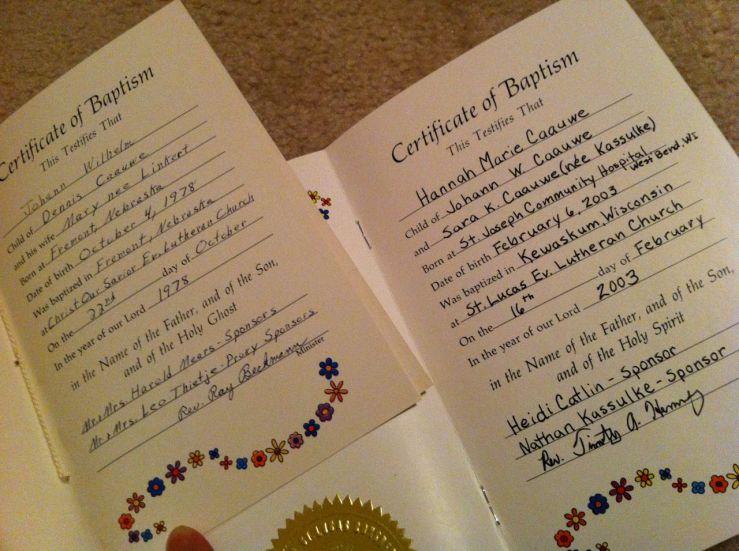
Eight years ago today, our oldest child, Hannah Marie, was baptized into the name of the Triune God. I noticed, as I was going through a few things, that both of us were given the same style of baptism certificate (see photo). It’s actually quite remarkable that almost identical certificates were available for 25 years with hardly any changes. I’m not sure if they are still available today. I didn’t see them at either NPH or CPH.

I like the fact that Hannah and I have the same certificate, but I’m not sure I would have chosen these. As a pastor, I have tried several options for baptismal certificates for children baptized in our congregation. I have tried a few different styles of purchased certificates. I have also, more recently, created my own certificates. I have also felt that it was nice to have a certificate that could be framed to hang on the child’s wall. The certificate that Hannah and I have is part of little booklet, which is not meant for framing. The other thing is that the certificate should be well designed, and have an official look to it. It should look like something meant to be displayed.

Many of the certificates available for sale are okay, but were never quite what I was looking for. The certificates I made were okay, and I thought they looked fairly nice, but there was something missing.

Recently I came across baptismal certificates which are newly designed to underscore the permanence and significance of baptism. They look like the kind of certificates your grandparents or great-grandparents might have received. They are beautifully illustrated with biblical scenes which picture or connect to baptism. They are meant to be printed large (11×17) and specifically meant to be framed and displayed. You can get more information about these certificates here: http://wolfsoncreative.com/

There are other places where you can find vintage baptism certificates, as well as other kinds of certificates (CPH and Agnus Dei Printing). But I have chosen to give these a try, as the best combination of a classic look, modern convenience, and reasonable cost.

If you’re looking for baptismal certificates for your church, give these a try. Either way, try looking for your own baptism certificate. See if it’s something you can put in a frame and place it somewhere where you can be daily reminded of the life-giving water by which God poured on you the forgiveness of sins and all the benefits of his cross.


A Prayer

A Prayer, when a person wants to go to the confessional and desires Holy Absolution.

“Lord Jesus Christ, my Redeemer! You have bequeathed to your dear church here on earth, and to her faithful servants, the holy office of the keys with its attached promise that the same thing which is bound and loosed here, should also be bound and loosed in heaven. For such gracious means I give you eternal honor, glory and praise. And since I—a poor, enslaved sinner–need this comforting releasing key, and so that I might not be held under the chains of this hellish jailor, I ask from the bottom of my heart that you would grant this to me through my Christian confessor, and for the sake of your blood and death, graciously release me from all my sins, grant me your Holy Spirit, that I receive the Holy Absolution in true repentance and undoubting confidence, good intentions, brotherly love, and thankfulness, and finally, be saved eternally. Amen.”

From: Evangelical Lutheran Treasury of Prayer (Gebets-Schatz), 1884. #298

Baptized into Christ

On Sunday, January 9th, Joanna was baptized into the name of the Triune God. This was also the First Sunday after the Epiphany, on which we observed the Baptism of our Lord. Since we had family in town for the baptism, we decided to have the group sing in the service. We sang Kevin Hildebrand’s setting of “God’s Own Child I Gladly Say It.” The kids sang the first stanza, the adults sang stanzas two and four, and the congregation joined in on stanzas three and five. The video below is the first stanza. It was recorded from the back of church, where the piano and clarinet were playing, but you can still hear the kids singing.