“Yet we dare not in this regard follow the fanatics, as if the human sciences were utterly useless or even detrimental to the knowledge of the Holy Scriptures and heavenly teaching. It is certainly necessary to study languages and well-informed grammars. Dialectic, rhetoric, and familiarity with the rest of philosophy is beneficial as well, and even quite necessary” (100).
“It will also be very beneficial to apply to an obscure place or to an entire writing the Lydian stone of the rules of logic, whether grammar, rhetoric, or finally, dialectic. Since these arts are indeed made known to use through the the beneficence of God and lit from the natural light that is all the time over us, and since they conform with the nature of things and the order that God has assigned to them, and finally, since they accommodate themselves to the human ability for comprehension (as the Sacred Scriptures), they will necessarily be of great benefit to us in the illumination of the Sacred Scriptures, if we apply them piously and cautiously” (111).
I’ve just updated my reading list for 2016. The list isn’t quite as long as in some recent years, but there is some pretty heavy reading in the list.
If I had to pick a few favorites, I would say that the most interesting and useful books were Chemnitz’ Church Order and Loehe’s The Pastor. I had been waiting to get my hands on that work of Chemnitz for years, and while reading the Loehe book, I found myself repeatedly wishing I had access to it ten years ago (especially his advice for pastors just starting out in the ministry). Both of these translations were just published this year.
I re-read Bo Giertz’ The Hammer of God again this year. That’s always a favorite. What strikes me is that it seems like it reads faster and faster every time I read it. I’ve probably ready it six times or more now. See this post on re-reading books.
As far as pure enjoyment, I would have to say that Katie Schuermann’s two books were the most delightful. Every Lutheran should read these, if only to get you warmed up for reading The Hammer of God. Schuermann has said that Giertz’ writing is an inspiration and influence on her own writing. I think it shows.
My book reading stack isn’t as big right now as it has been in previous years, but I’m looking forward to some good reading in A.D. 2017. I’ve already started a re-read of The Brothers Karamazov, and I’m looking forward to finally getting to read de Tocqueville’s Democracy in America. I also have another volume of Gerhard’s Loci coming up.
What was the best book you read in 2016 and what’s on your list for the new year? Leave me a comment.
I was asked to write an article on teaching Latin in our synod’s elementary schools, which has been posted on the MLC Issues in Lutheran Education blog.
Aside from Martin Luther, MartinChemnitz (1522-86) is regarded as the most important theologian in the history of the Lutheran Church. Chemnitz combined a penetrating intellect and an almost encyclopedic knowledge of Scripture and the Church Fathers with a genuine love for the Church. When various doctrinal disagreements broke out after Luther’s death in 1546, Chemnitz determined to give himself fully to the restoration of unity in the Lutheran Church. He became the leading spirit and principal author of the 1577 Formula of Concord, which settled the doctrinal disputes on the basis of Scripture and largely succeeded in restoring unity among Lutherans. Chemnitz also authored the four-volume Examination of the Council of Trent (1565-73), in which he rigorously subjected the teachings of this Roman Catholic Council to the judgment of Scripture and the ancient Church Fathers. The Examination became the definitive Lutheran answer to the Council of Trent, as well as a thorough exposition of the faith of the Augsburg Confession. A theologian and a churchman, Chemnitz was truly a gift of God to the Church. (The Treasury of Daily Prayer, CPH)
Last week I received a Call to serve at St. John’s Lutheran Church in Juneau, WI. I would be grateful for your prayers on behalf of me, my family, and these two congregations.
Every Wednesday, we pray Matins at church. We usually read an Old Testament selection from a daily lectionary. Then I usually comment on the Epistle from Sunday. Today, we commemorated the Lutheran hymnwriters Nicolai, Heermann, and Gerhardt and sang the Queen of Chorales. The other thing we regularly do is pray by name for the members of the congregation.
But every week I look forward most to singing the Te Deum Laudamus. Today, this sight gave me all the more reason to sing, and I think the angels, apostles, prophets, martyrs, and Church throughout the world rejoice at this, too.
God’s own child, I gladly say it: I am baptized into Christ!
He, because I could not pay it, Gave my full redemption price.
Do I need earth’s treasure’s many? I have one worth more than any
That brought me salvation free, Lasting to eternity.
Satan, hear this proclamation: I am baptized into Christ!
Drop your ugly accusation; I am not so soon enticed.
Now that to the font I’ve traveled, All your might has come unraveled,
And, against your tyranny, God, my Lord, unites with me! (CWS 737:3)
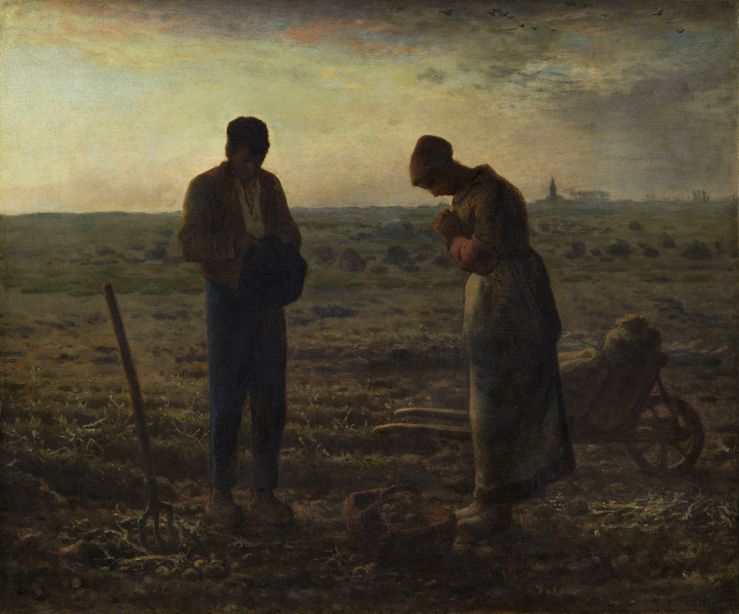
In Jean-François Millet’s The Angelus, two peasants stop digging potatoes to pray when the bells in the distance church tower ring.
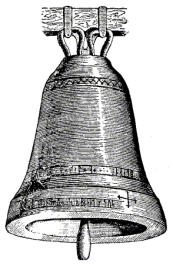
I suppose one could say that church bells are a thing of the past. Of course, there are places where churches still have bells, and those bells still ring. They might ring at the beginning or during services (during the Lord’s Prayer, for example). They might even still ring to announce a member’s death or at certain times of the day. But the fact is that most of us live, work, and travel out of earshot of church bells.
I’ve been reading Martin Chemnitz’ 1569 Church Order for Braunsweig-Wolfenbüttel. In it, he has instructions of all kinds for church life in his principality. Today I came across his instructions regarding the ringing of bells, right after a long list of collects (prayers).
Under the papacy, a special ringing of the bell was observed morning, noon, and evening by which the people were admonished to pray to the Virgin Mary. But because the most blessed Virgin Mary does not desire the honor due God alone, and because it is also contrary to God’s Word, the people are to be instructed in this regard. The ringing of the bell in and of itself can be retained, as is also the case in the neighboring Reformation churches, to indicate to the people morning, noon, and evening. Moreover, the people are thereby reminded and exhorted to pray morning, noon, and evening for common peace and good government—in so doing prayer is made at the same time for the authorities and against all enemies of common, Christian peace. For this reason, in the neighboring Reformation churches, it has been very appropriately referred to as ringing the prayer bell or the “peace bell.” And it is Christian, good, and useful for the common people to be accustomed to it, so that they do not forget such necessary prayer. But because prayer is often forgotten, the peal of the bell can remind them to pray such things, whenever they hear the peace bell ringing, whether at home, in the garden, on the road, or in the field. At that time also, the children in the house may be encouraged to sing: Erhalt uns Herr bey deinem Wort, etc.; likewise,Verleihe uns Frieden gnediglich. Such prayer is of very great necessity in these latter and perilous days.
Wouldn’t you say that prayer for the “common peace and good government” is still “of very great necessity”? And I’m pretty sure that forgetting to pray is no less a problem today than in 1569.
But if church bells are out—or perhaps drowned out by our world’s noise—is there anything that could fill the function of church bells to call us to pray? What could remind us, whether we are at home, at work, or in the car? Perhaps something that we carry with us practically everywhere.
Perhaps you could consider setting an alarm on your phone in the morning, at noon, and in the evening. You could even use the sound of bells to remind you to pray.
Verdin Bells has a few church bell sounds available for download on their web site. There is one called the Angelus (that’s the name of the papist bell-ringing Chemnitz refers to above) and one that is just a single swinging bell. Here are converted files for iPhone ringtones (Peace Bell / Single Bell).
Chemnitz encourages prayers for peace at these times. I think I might like to modify that just slightly with an area of focus for each hour—in the morning, for peace in the home and family; at noon (the hour of Jesus’ death), for peace in the Church; and in the evening, peace in the government and civil sphere. In another place I saw that some have used the morning hour to meditate on the Resurrection, the noonday to contemplate the Crucifixion, and the evening hour to reflect on the Incarnation.
The hymns Chemnitz suggests are also worth considering. Most Lutherans are familiar with “Lord, Keep Us Steadfast in Your Word” (CW 203). “Grant Peace, We Pray, in Mercy Lord” (CW 522) is worth knowing better. These two hymns always seem to be paired together. In J.S. Bach’s Cantata on “Lord, Keep Us Steadfast” the closing chorale is “Grant Peace, We Pray.” I love how it concludes:
Grant to our princes and all those in authority
peace and good government
so that we, among them
may lead a calm and peaceful life
in all godliness and honesty.
Amen.
“Yet we dare not in this regard follow the fanatics, as if the human sciences were utterly useless or even detrimental to the knowledge of the Holy Scriptures and heavenly teaching. It is certainly necessary to study languages and well-informed grammars. Dialectic, rhetoric, and familiarity with the rest of philosophy is beneficial as well, and even quite necessary” (100).


 Wouldn’t you say that prayer for the “common peace and good government” is still “of very great necessity”? And I’m pretty sure that forgetting to pray is no less a problem today than in 1569.
 A Shepherd's Story