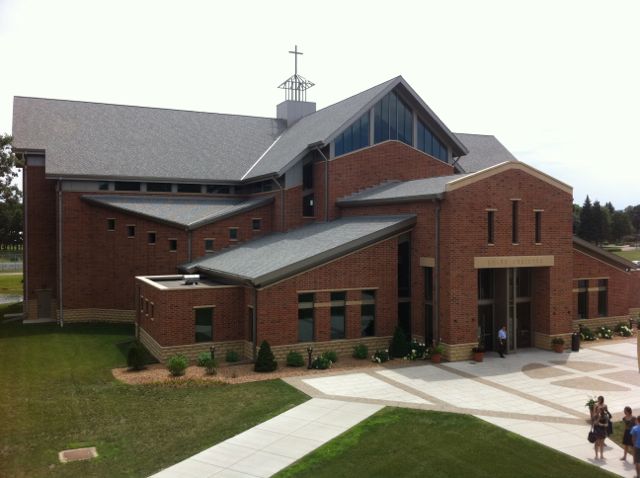
Now that to the font I’ve travelled…

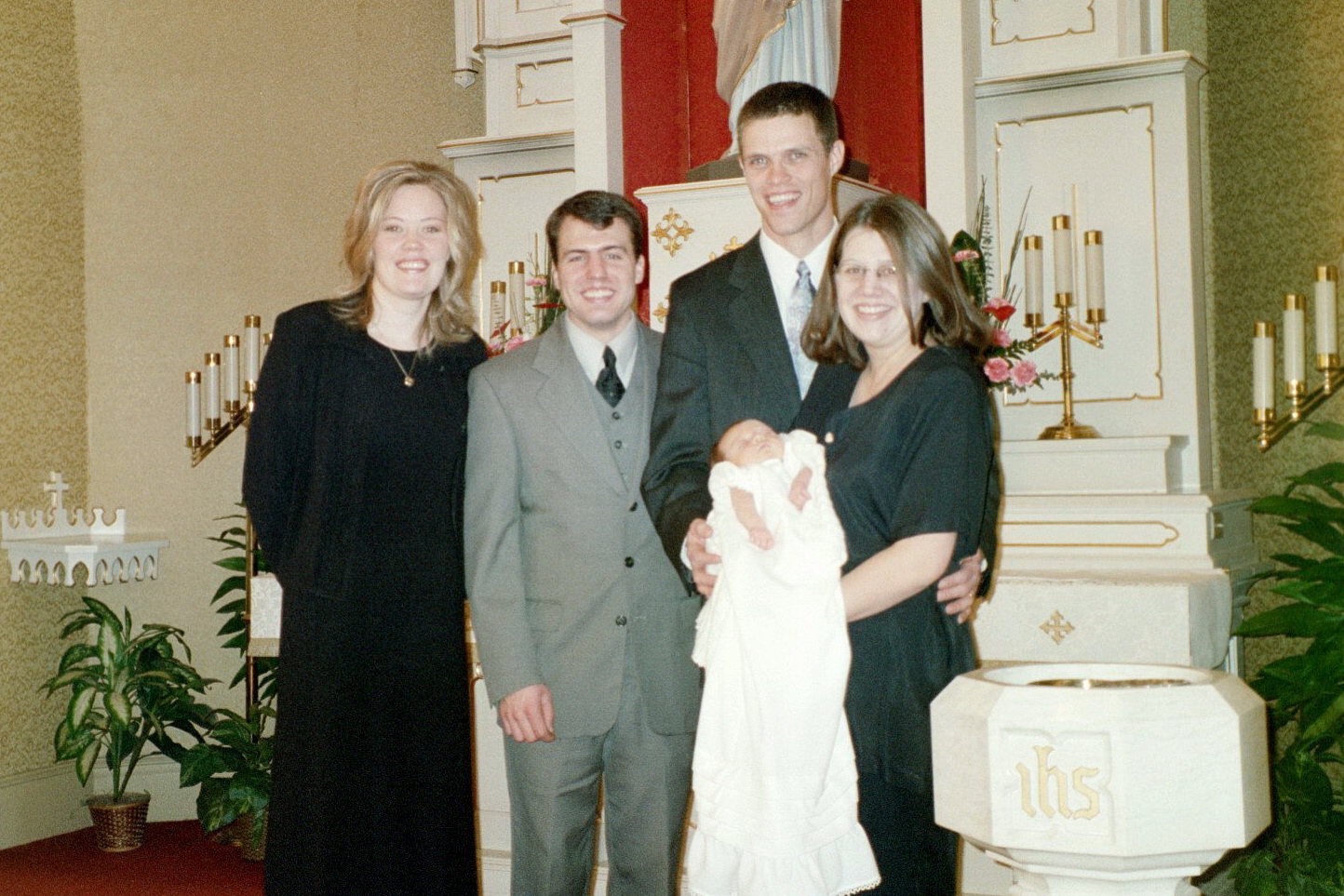
Nine years ago today we brought our firstborn daughter Hannah to be crucified and buried with Christ in Holy Baptism. Since that day, we’ve been back to the font many times. Actually, we have been to three other fonts for our five other children. And God-willing, we’ll be back at the font again in just a matter of weeks, as we are awaiting the appearance of our seventh gift of God. Each and every trip impresses on me more and more that “there is nothing worth comparing to this life-long comfort sure.”

But that is not to say that my only trips to the font have been to be baptized, to baptize, or to bring my children to baptism. No, this font is a daily destination. For this is the only water that can wash away what has been wrong today and drown the old Adam who loves to swim. The daily activity starts with the sign of the cross. “In the name of the Father and of the Son and of the Holy Spirit.” It confesses “I believe” and it prays “Our Father.” From there, this daily activity gets going, singing a hymn perhaps, busy with vocations like father, husband, and pastor. Until the day is over and again we finish at the font. “Forgive me all my sins, and graciously keep me this night.”


2011 Reading

Here is a list of the books that I have read in the past year. As in prior years, I cannot recommend every book on the list, but many were simply outstanding. Email me or leave a comment if you want to know what I thought of any of these books.

  1. God So Loved the World (Lyle Lange, NPH)
  2. Whether Soldiers, Too, Can Be Saved (Martin Luther LW 46)
  3. Positively Lutheran (John Braun, NPH)
  4. The Kingdom of Christ (J.P. Meyer)
  5. Dying to Live (Harold Senkbeil)
  6. The Papacy Evaluated (E.G. Behm)
  7. Johann Kilian, Pastor (George Nielsen)
  8. A Tale of Two Synods: Events That Led to the Split between Wisconsin and Missouri (Mark Braun)
  9. The Christian & Birth Control (Robert Fleischmann)
  10. Working the Angles: The Shape of Pastoral Integrity (Eugene H. Peterson)
  11. On Being a Christian: a personal confession (Henry Hamann)
  12. Motivation for Ministry: perspectives for every pastor (Nathan Pope)
  13. Crime and Punishment (Fyodor Dostoyevsky)
  14. First Conversation (Bethesda Institute)
  15. What in the World Is Going On?: Identifying Hollow and Deceptive Worldviews(David C. Thompson)
  16. Down Range: to Iraq and Back (Bridget C. Cantrell, Ph.D., & Chuck Dean)
  17. Examination of the Council of Trent, part 2 (Martin Chemnitz)
  18. Why Johnny Can’t Sing Hymns (T. David Gordon)
  19. The Cradle and the Crucible: A history of the forming of the Arizona-California District (Charles E. Found)
  20. The Ministry of the Word (John Brug)
  21. Ministry, Word, and Sacraments: An Enchiridion (Martin Chemnitz)
  22. Gazelles, Baby Steps, and 37 Other Things Dave Ramsey Taught Me About Debt (Jon Acuff)
  23. Strong Father, Strong Daughters (Dr. Meg Meeker)
  24. The Hammer of God (Bo Giertz)
  25. Luther’s Liturgical Music (Robin Leaver)
  26. Why Johnny Can’t Preach (T. David Gordon)
  27. The Theology of the Cross (Daniel Deutschlander)

The most useful things I read this year were the two titles by Martin Chemnitz. They do not call him the “second Martin” for nothing.

The Amazon Kindle has made an impact on the way I buy and read books. Only two of the books on this year’s list were read on my Kindle, but that’s mostly because I had more than a year of reading in my “to-read” pile. That pile is beginning to dwindle, and I suspect that more than half of the books I read in 2012 will be in Kindle format. There are some books that I will still prefer to have and use in hard copy—especially reference books that won’t be read straight through. But right now I have at least three books loaded on my Kindle ready to read as soon as I get to them.

Nicolai, Heermann, Gerhardt

This morning I read this description of these three Lutheran hymn writers in The Treasury of Daily Prayer (actually I read it on the iPad app version, PrayNow).

Philipp Nicolai (1556–1608) was a pastor in Germany during the Great Plague, which took the lives of 1,300 of his parishioners during a sixth-month period. In addition to his heroic pastoral ministry during that time of stress and sorrow, he wrote the texts for “Wake, Awake, for Night Is Flying” and “O Morning Star, How Fair and Bright,” known, respectively, as the king and queen of the Lutheran chorales. Johann Heermann (1585–1647), also a German pastor, suffered from poor health as well as from the ravages of the Thirty Years’ War (1618–1648). His hymn texts are noted for their tenderness and depth of feeling. Paul Gerhardt (1607–1676) was another Lutheran pastor who endured the horrors of the Thirty Years’ War. By 1668 he lost his pastoral position in Berlin (for refusing to compromise his Lutheran convictions), and endured the death of four of his five children and his wife. He nevertheless managed to write 133 hymns, all of which reflect his firm faith. Along with Martin Luther he is regarded as one of Lutheranism’s finest hymn writers.

If I started writing about the significance of these three men in Lutheran hymnody, I would never finish. So I’ll just share a few links and comments about each of them.

Philipp Nicolai

The King: Wake, Awake
There is hardly anything better than Bach’s cantata (BWV 140) on this hymn, especially the choral settings of the 2nd and 3rd stanzas. Get it on Amazon. I especially love this brass setting of the final choral.

The Queen: O Morning Star, How Fair and Bright (How Lovely Shines the Morning Star)

Johann Heermann
When I was a kid, I used to page through the hymnal looking for hymns written by “Johann”s. It was a bonus to find hymns with both text and tune by someone who shared my name (especially because I didn’t know any real/living people who shared my name).

Feed Your Children God Most Holy – we sing this regularly at meals in our home, especially when the whole family is together or when we have guests in our home.

O God, My Faithful God

O Dearest Jesus

Paul Gerhardt
Here is a German documentary on Gerhardt life, work, and significance. I suspect, though, that many of the people interviewed, who appreciate Gerhardt’s hymnody and poetry, totally miss the main and central point of Gerhardt’s hymns—Jesus.

O Jesus Christ, Your Manager Is
Post 1
Post 2


Lobet den Herren – I have found this simply enchanting. I have sometimes said that it would have been worth learning German just to be able to sing Paul Gerhardt hymns.

Now Rest Beneath Night’s Shadow
March 10, 2008 Post
Evening Hymn – April 12, 2011


Johann Heerman

Cranach in the Study

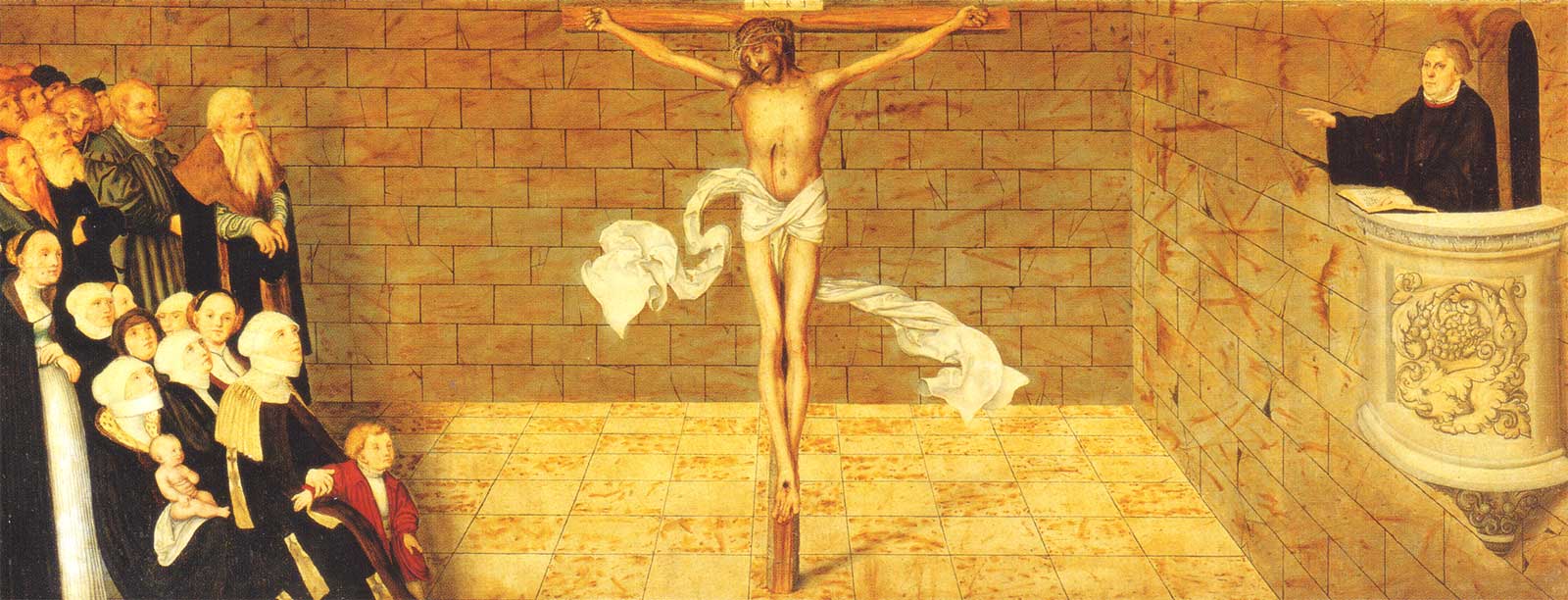
Over ten years ago, a friend introduced me to this painting he saw while touring the Luther lands in Germany. It’s a part of an altarpiece of St. Mary’s Church in Wittenberg—the church where Luther regularly preached.

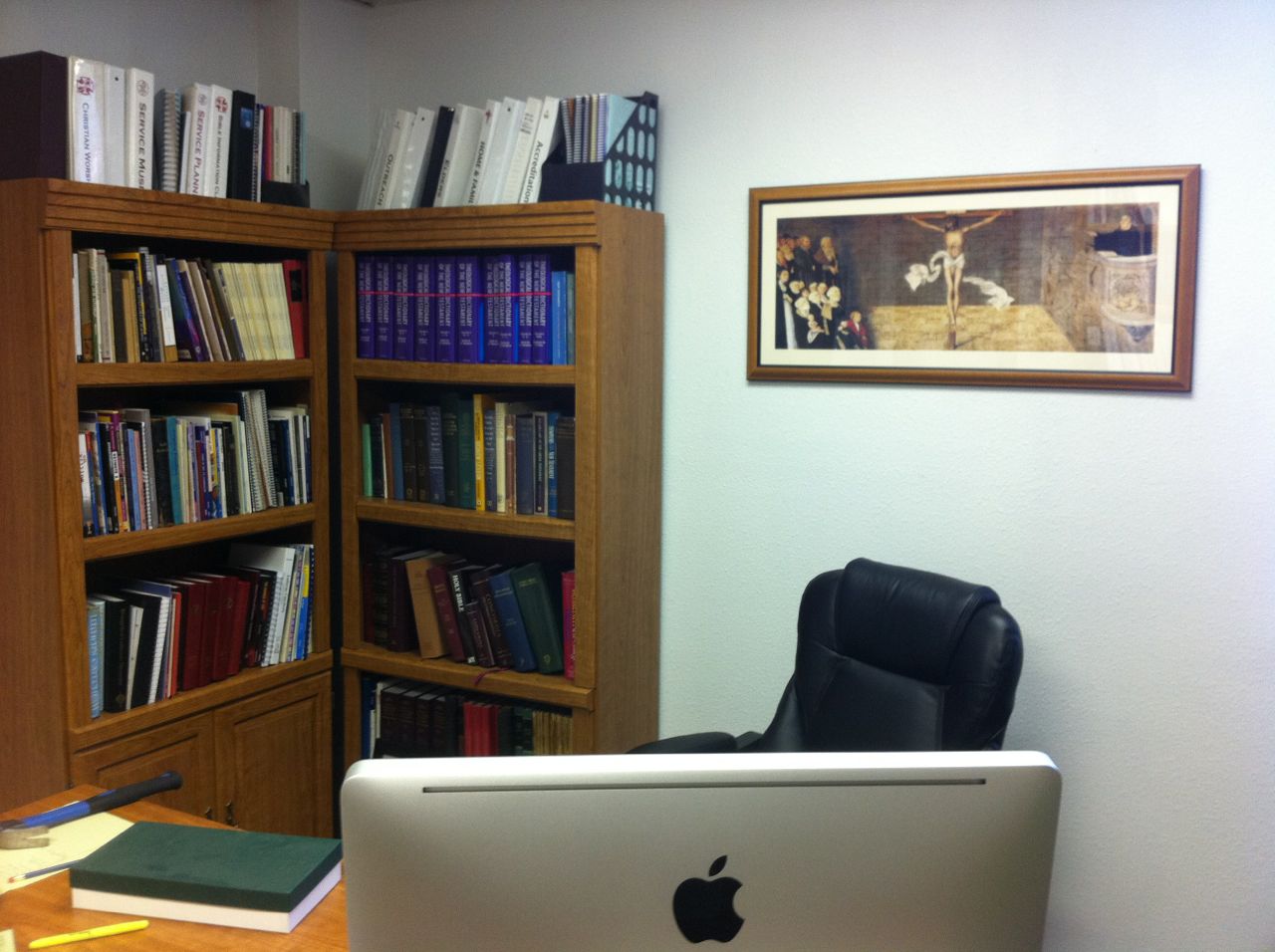
Ever since, I have always thought that this would make an excellent piece to have hanging on the wall of my study. Today, I got my wish. I was able to order a giclée reprint from art-prints-on-demand.com and then had it framed at a local frame shop here in northeast El Paso.

Here is what strikes me about the painting:

  • Luther’s preaching points to Christ. He is preaching from the Scriptures, but the Scriptures always point us to Jesus. Therefore preaching should do the same. Preaching is not primarily aimed at educating or entertaining people, nor is it primarily aimed at changing people’s behavior. But it is to point to Christ who hung on the tree in place of sinners.
  • The congregation listens to Luther preaching, but their attention is also on Christ. They see Christ and hear Christ. Jesus should always “get in the way” between the preacher and the parishioner. This, then, is how the laity evaluates preaching—by what the preacher says about Jesus.
  • The congregation is made up of young and old. The congregation includes the youngest of those who believe in Jesus. Babies sit with an unobstructed view of Christ—at the front of the church. They, too, need Jesus. They, too, hear and see Jesus in the divine service. They, too, receive the gifts of Christ.

God Feeds His Children

This quote is from a collection of text studies arranged for the church year and published in the 1850s and 1860s. They were compiled from the Harmony of the Gospels by the Lutheran theologians Martin Chemnitz, Polycarp Leyser, and Johann Gerhard, published from 1593 to 1652. This section is on the Gospel for the Seventh Sunday after Trinity, Mark 8:1–9, which is talking about the disciples’ lack of trust that Jesus could provide food for 4,000 as he had for the 5,000.

Let us also recognize our own lack of trust, which frequently tends to plague us in household affairs, when perhaps God grants more children and entrusts a larger family to us for their maintenance. Then these kinds of words are commonly heard: Where will I get enough bread to satisfy this bunch? Where will I get the money and the means, so that in such a precarious situation I will be able to take care of me and my own? But trust in God—He, who gives fodder for the cattle and for the young ravens, who call on him (Ps 147:9)—He will also nourish you. Say to your hearts: Why do you torment yourself with useless worries? God is your Creator; he has given you your body and soul; he will also give you food.

Echt evangelische Auslugen der Sonn- und Festtags-Evangelium des Kirchenjahrs,
übersetzt und ausgezogen aus der Evangeliien-Harmonie
der lutherische Theologen M. Chemnitz, Polyk. Leyser und John. Gerhard.
Vierter Band. 1864. p. 113

A Faithful God—From Generation to Generation

The story goes in my family that my great-grandmother, Anna Schindeldecker Linkert (pictured right), sang to her mother as she was dying. According to the story, she sang the stanzas of Johann Heerman’s hymn, O Gott, du frommer Gott (O God Thou Faithful God – TLH 395, CW 459, LSB 696). The hymn closes with these stanzas (omitted from CW):

If Thou a longer life
Hast here on earth decreed me;
If Thou through many ills
To age at length wilt lead me,
Thy patience on me shed.
Avert all sin and shame
And crown my hoary head
With honor free from blame.

Let me depart this life
Confiding in my Savior;
Do Thou my soul receive
That it may live forever;
And let my body have
A quiet resting-place
Within a Christian grave;
And let it sleep in peace.

And on that solemn Day
When all the dead are waking,
Stretch o’er my grave Thy hand,
Thyself my slumbers breaking.
Then let me hear Thy voice,
Change Thou this earthly frame,
And bid me aye rejoice
With those who love Thy name.

By the time the hymn was over, her mother was with Jesus. Great-grandma Linkert must have taught the hymn to her children (perhaps all 15 of them). At least one of them, my Grandpa, knew it and sang it often. In fact, when my mother was in her early teens, Grandpa even offered his family an incentive to learn this hymn by heart: one dollar for each stanza. On Saturday nights, Grandpa was ready with his dollar bills, ready to listen to his daughters or foster sons recite their stanzas.

Because my mother knew that hymn by heart, she could easily sing it while rocking each of her seven babies to sleep, or by their bedside. Because this hymn was frequently heard and sung in our home, it now has the chance to make it one more generation (despite the fact that half of it isn’t even in our hymnal).

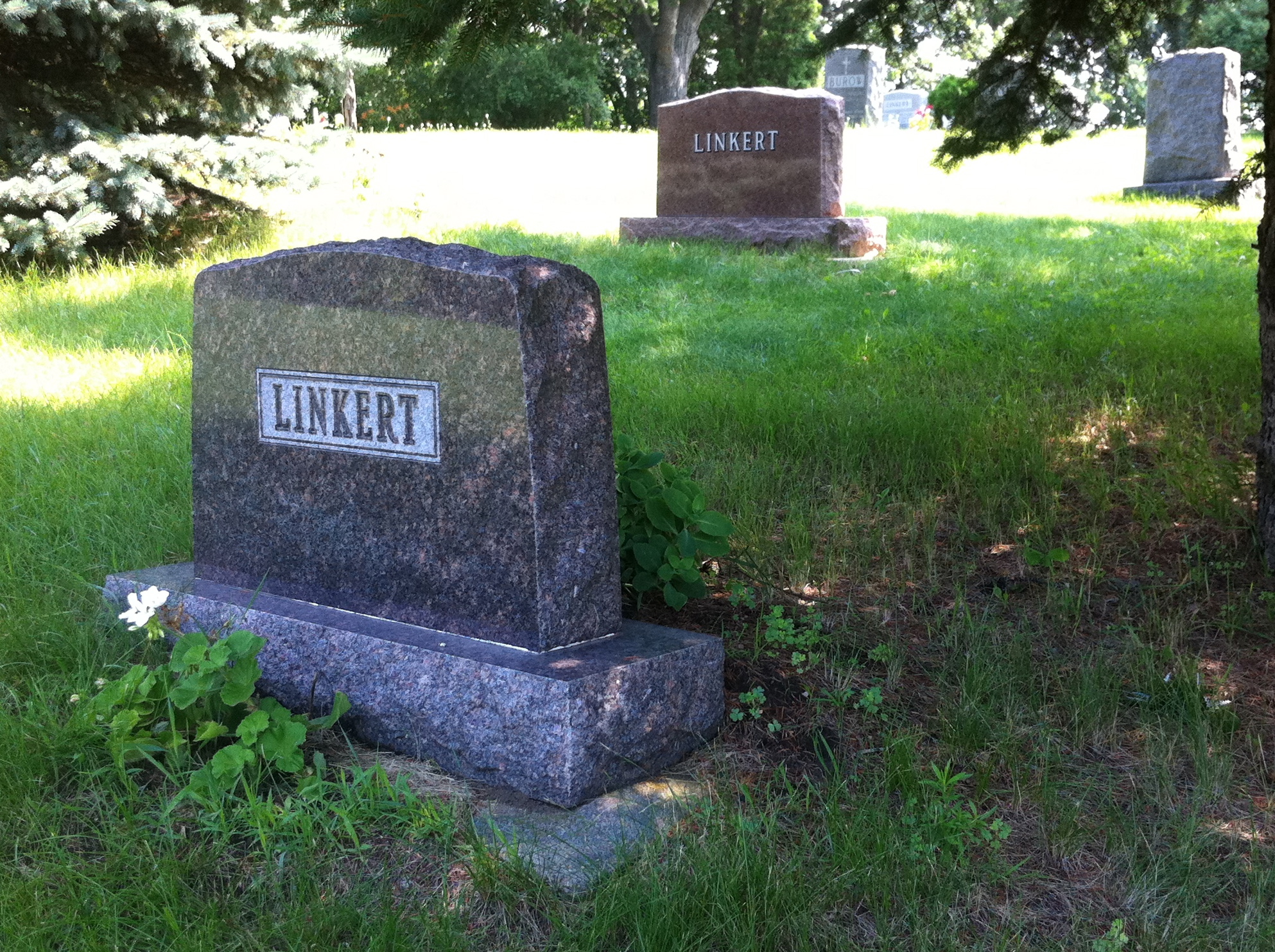
While I was up in Minnesota I had to chance to stop at the cemetery in Eagan where my Mom’s parents and grandparents are buried. The mortal remains of those generations who sang “O Gott du frommer Gott” now lie beneath those stones, still resting, still waiting for stanza eight: “Then let me hear Thy voice, Change Thou this earthly frame.”

But I am so grateful that they sang the hymn while they were here. Not only did it teach them and comfort them, but to this day their song continues to teach me and comfort me by the words they passed from their generation to the next. And they have given a voice for me to pass on to my children the fountain of gifts which come from this faithful God, and to prepare them for all of life that is ahead of them.

Kindle

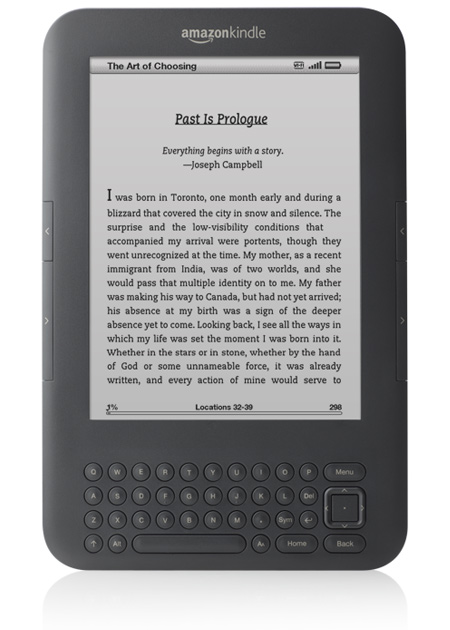
Over a month ago I bought myself an Amazon Kindle. For those of you who haven’t seen these or heard of them, the Kindle is an electronic book-reading device.

I should mention that this decision was a bit of a dilemma for me. On the one hand, I am a techy guy who loves gadgets. On top of it, I’m a big Apple user and am very interested in devices like the iPad. But on the other hand, I love books. Real books, with real paper. I hate to read longer documents on computer screens, and only do so when absolutely necessary.

But I bought a Kindle. And I love it. Here’s what sold me (and a few reasons I bought this rather than just saving up for an iPad).

Reading on a Kindle is like reading a book. It really is. It’s not a back-lit screen, but what they call their e-ink technology. It doesn’t seem to cause the same kind of eye strain that you would have with an LCD display, nor do you get glare from surrounding light. I know that the iPad has a great e-book reader, and there is even a Kindle app which can be used on the iPad and iPhone. But for the reading experience, the Kindle display wins hands-down.

Shelf Space –  I am now getting to the point that I really don’t have much more room in my study at church for too many more books. My shelves are nearly full. I don’t think this means that I will never buy a hard-cover book again, just that I need to be more judicious about which books deserve a place on my shelf. I’ll save the paper for books that I will want to have on hand, like reference books, lexicons, and some of those classics that I’ll want to fill with marginal notes and highlights. But for many volumes, I will be happy to be able to carry them all around in an 8.5 ounce device.

Cost – The Kindle is available for as low as $114. Obviously, this doesn’t really compare to something like the iPad, because the Kindle basically does one thing, and does it very well. The iPad does lots of things really well. And that is reflected in the price. There are also free readers available for Mac and PC, iPhone and iPad, Android, etc. Additionally, many of the books available on Amazon are cheaper in Kindle format than their print counterparts. And no one has to pay to ship an e-book to you since it is immediately available on your devices. I already prefer to buy books from Amazon.com, because their books prices are generally cheaper and because it’s easier to qualify for free shipping than most other online retailers. The Kindle store even has books from smaller publishers like Concordia Publishing House, which carries a great selection of Lutheran material.

Another great feature is the ability to send personal documents to read on the Kindle. This is great for longer documents (Word, PDF, RTF) that I have on my computer, but in order to read it I would either need to read it on the computer screen or print it out. Most often, these are things like essays and papers. Reading it on the Kindle is much more pleasant than any alternative.

The Kindle even gives me the ability to share highlighting and notes. It’s that much easier than typing out interesting quotes and then posting them to something like a Tumblr account. Here all I need to do is select the section, type a note, and post.

So, as you can tell, I’m sold. If you do lots of reading, and would appreciate the portability and convenience, I would highly recommend the Kindle. If you’re not interested in an e-reader, but want all the features of the iPad, go ahead and save your pennies. I hope that someday I might be able to have that, too. [One interesting side note: I have talked to a few people who have never been avid readers, but having this device has sparked their desire to read considerably more.]

If you are already a Kindle user, go ahead and follow me here.
Worship Conference

There are no words which can adequately describe the experience of attending the WELS National Conference on Worship, Music, and the Arts. The best I could do would be to encourage you to view online the two services which were held on the Martin Luther College campus in the Chapel of the Christ. Of course, it’s not quite like being there, but maybe it gives you some idea.

The theme of this year’s conference was handing down the Lutheran heritage to the next generation. WELS President Mark Schroeder, who was just re-elected to another term today, wrote in his introductory letter to the conference:

Lutherans have been blessed with a rich heritage—an astounding array of spiritual treasures, passed down to us over the centuries through faithful Christians who have gone before us. It’s a biblical heritage that grounds us firmly on the Words of Scripture. It’s a confessional and theological heritage that connects us to faithful confessors and to the church of all ages. And it’s a liturgical heritage that respects our roots and values commitment to worship that focuses on the proclamation of the gospel in all its beauty.

We Lutherans today are the beneficiaries and recipients of such a rich heritage. But blessings such as those we’ve received bring with them a solemn responsibility. Our heritage is one to be treasured for ourselves to be sure, but it is also one that we will want to pass along to the next generation of Lutheran Christians. By treasuring this heritage for ourselves, we keep the gospel of Jesus Christ as the focus of our worship and of our efforts to bring the good news of Christ to a fallen world. By passing this heritage to the next generation, we take our place in a long line of faithful witnesses, as “one generation commends [God’s] works to another” (Psalm 145:4).

Throughout the week, this theme was expressed in several ways, most notably in the keynote address, in the 48 voice children’s choir assembled for the conference, and in a number of the presentations.

It was under this theme that I presented the topic of “Hymns in the Life of Church, School, and Home.” I maintain that the church’s song—especially her hymns—provides us with a vehicle for passing the faith on to the next generation. This happens when these songs not only provide musical accompaniment for the proclamation of the gospel in corporate worship, but especially when these hymns accompany the lives of the church’s members. It starts with children at a very young age; when hymns are learned young and learned well, they provide for a lifetime of comfort and strength.

I have created a web page with all kinds of information related to this topic. There you can find links to all the books, presentations, CDs, etc that I referred to in my presentation. On the page you can also view the slides I used. Keep in mind that the slides are not the presentation itself; they were mainly used to illustrate the stories I used to make various points. If you click through the slides you will see various images, videos, and audio clips. Over the next several days I hope to post a few of the stories to which those slides refer.

Hymns and Children

Yesterday I heard an interesting segment of Issues, etc, on teaching hymns to children. You can listen to the segment here.

This covers some of the same ground that I will be presenting in a few weeks at the WELS National Conference on Worship, Music, and the Arts in St. Peter, MN.  Here is a description of my presentation:

A Lutheran hymnal is a rich devotional resource that deserves to be used in every church, school, and especially, in every home. Already at a very young age, children are capable of learning hymns and participating in worship. These hymns provide solid teaching and strong comfort for Christians, young and old alike. This presentation provides practical and inspiring ideas and anecdotes for teachers, parents, pastors, and all who influence children and worship.

After the conference, I will post my presentation and materials here. But I’m looking forward to seeing some of you in Minnesota in just a few weeks.