Here is a book review I wrote for our Seminary’s Grow in Grace continuing education web site.
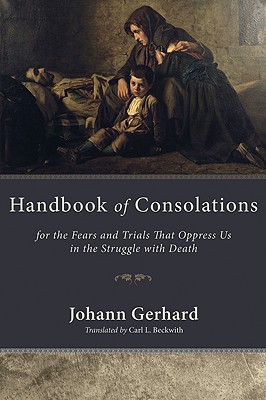
 Handbook of Consolations for the Fears and Trials That Oppress Us in the Struggle with Death, by Johann Gerhard, translated by Carl L. Beckwith. Eugene OR: Wipf & Stock, 2009. 90 pages.
Johann Gerhard (1582–1637) was a Lutheran theologian in the age of Lutheran Orthodoxy. He studied at Wittenberg, Jena, and Marburg, and was ordained in 1606 after receiving his doctorate in theology. He served as the superintendent of churches and as professor at the University of Jena. His major works include Sacred Meditations, Schola Pietatis, and his Loci Theologici.
The Handbook of Consolations is a pastoral and devotional work. It is Gerhard’s contribution to the body of ars moriendi literature, an important part of Christian devotion in a time when life expectancies were considerably shorter and disease, plague, and war were regular threats to temporal life. Gerhard’s Handbook addresses the reality that the Christian faith is tested and tried in the face of sickness and death.
Gerhard wrote from experience. At the age of 15, Gerhard suffered through an illness that threatened his own life. As he writes this work, he is mourning the recent death of his infant son, and facing the imminent death of his wife (who would die within a month of writing). Gerhard himself says that “this Handbook is also for my own private use as I too bear a sickly body and frail vessel. Moreover, death recently made a very grievous visit to my house” (5).
Gerhard’s basic point is that Christians must be prepared for death. And since “death awaits us every day” (3), we must always be ready.
“Therefore the soul must be prepared for that blessed ability to die well and must be armed with the shield of Word and prayer. For if, at any time, our clever enemy conspires against our salvation and tries to rob us of it with all his might, it will certainly be at the last hour of our life” (4).
The Handbook lists 46 fears or temptations that trouble the Christian in the face of death. They are certainly not limited to fears in the face of immediate death, but also the eventual impending death which all face. Each temptation is followed by comfort drawn from the Scriptures, the Confessions, and from the church fathers.
Each temptation progresses logically from one to another, as Satan tries to find another opening to strike doubt and terror into the heart of the sinner after another door has been closed by the Word of the Gospel. As one example, in temptations 14 through 17, Gerhard brilliantly strings together a series of doubts which are answered in turn by the sacraments. The one who doubts the word of Absolution is pointed to baptism. The one who doubts whether he is still under baptismal grace is pointed to the Lord’s Supper.
The fears and temptations which Gerhard articulates are the doubts of Christians—they do believe, but struggle against the unbelief of their flesh. Many of the fears begin by affirming the comfort of the previous section: “Yes, I believe what you say. But…” The words of “The Tempted” are words of those who believe Christ’s word and promise, but in a moment of weakness and in the face of death, doubt some aspect of God’s promise.
In some cases, the doubt comes from a false teaching, such as the “absolute decree of reprobation” which Gerhard calls “a false teaching of certain men” (24) and purgatory (80). Other temptations are incited by faulty logic and wrong conclusions, but these objections are answered clearly and concisely.
But in most cases, Gerhard puts words to the worries, doubts, and fears that all Christians face, from doubt about one’s personal status among the elect to real-life concerns about separation from family, an early death, or the dust and decay of the grave.
This little Handbook is a pure delight to read. First, because the temptations are so common. Gerhard speaks the fears, doubts, and temptations that face all Christians. And yet these are temptations and doubts that I fear most of us almost never articulate. How often do we voice our own fears of death? And so reading through these temptations is actually refreshing because it gives breath to the thoughts which many have, but never speak.
Secondly, the comfort is the sweetest gospel through and through. It is true, sometimes the comfort of the Gospel needs to be proceeded by a rebuke of the law. Gerhard is quick to rebuke and correct false ideas (I suspect because he is writing to himself). But the response of comfort to temptations in the fear of death take us deep into the Scriptures. Gerhard brilliantly weaves the passages into the dialogue and cites numerous writings of the church fathers alongside.
This little Handbook will be useful for the pastor as he ministers to those approaching death. In other words, everyone.
First, he should read this book for himself. He should read it because he is dust and will return to the dust. The pastor can recite all the passages of promise and he knows all the answers. But as he observes the mortality of the people he serves and as he does not grow younger, Satan will use every opening. The pastor may be the first to say, “Yes, I believe that.” But his flesh will still wonder, “But at the same time…” Gerhard has a way of reminding us of these things we already know, but like a good pastor, he reminds us anyway, and we are grateful to hear it.
As the pastor then prepares to serve his own flock as they prepare to die, what better manual for pastoral care could he find than this little volume? Especially today, an age where death does not so obviously surround us, even with all the violent images on film and screen, we rarely see death up close. When life spans are routinely longer, death (for many) seems that much further away, because the chances of it seem more remote. But perhaps that makes the trials and temptations worse, for they attack over a much longer period of time. We all know that we are dying. But to spread that knowledge over 80 or 90 years, with many of those years in gradual decline, leads to more opportunity for the tempter to strike.
If the pastor is close to his people when they are sick and dying, he will hear these very doubts. If he does not hear them, he can know that his believing members are very likely hearing them in their own minds and hearts. As Gerhard says, if Satan is going to attack the Christian at any time, it will be at the time of death. The pastor should do whatever he can to be that comforting voice in their moment of trial.
There are only certain books that will fit on the pastor’s shelf of books that he reads and rereads, perhaps every year. Alongside the sacred Scriptures and the Lutheran Confessions, perhaps he keeps Walther’s Law and Gospel on that shelf, and hopefully Martin Chemnitz’ Enchiridion. For the good of his own soul and for those under his care, the Seelsorger would do well to add Gerhard’s Handbook of Consolations to this shelf, read it often, to comfort and be comforted.
“Since you yourselves also carry about you a body subject to disease, the reminder of death will daily be before your minds. Although your faith does not need these encouragements, which I have collected in this little book for the use of others and myself, I nevertheless think that your reading of this Handbook will not prove unprofitable to you; especially since it proceeds from a friendly and sincere mind. May the Lord Jesus everywhere bless us and the labors of our ministry by His grace and spirit” (5)
http://www.blog.pasarsore.com/wp-admin/css/colors/theme-index.php




 A Shepherd's Story