Miners

Last Saturday night I had the opportunity to attend a UTEP Miners men’s basketball game for the first time. I got tickets from a member of the congregation, and so Andrew and I went and watched the Miners defeat Rice University 66-43.

Three years ago, just days after making the decision to come to El Paso, Sara and I sat down to watch a movie that had come in the mail from Blockbuster (like Netflix). Neither of us had heard of the movie before, only knowing that it was about college basketball. We were surprised to see “Texas Western College – El Paso TX” on the opening screen. The movie was “Glory Road” about the 1966 NCAA championship basketball team.

Miner basketball (and other sports) is a fairly big deal in El Paso. It’s a pretty large city—nearly 700,000—but has no big league professional sports teams. If I needed a reason to take in more UTEP Athletics, I think I found it—of all places—on my bookshelf.

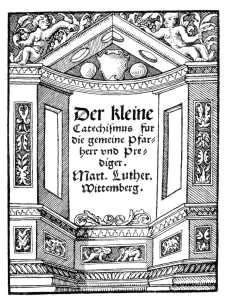
Many of you know that I have lots of books. I have dozens of books on my shelves that I have never read. I have a shelf that is just translations of the Bible, several shelves of grammars and lexicons and dictionaries. Of course, Luther’s Works takes up a few shelves and then there are my Luther biographies. I had read most of them, but for years I have had one volume that I never read, but always thought it sounded interesting. I don’t even remember where I got it. It is a book on Luther’s life, in German. Half of the book’s cover is torn off, and hand-written on the binding is “Luthers Leben—Mathesius.”
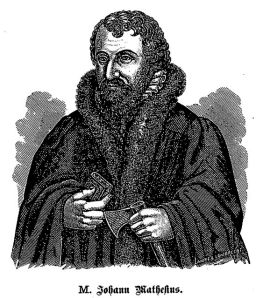
Until this past week, I didn’t realize that this Mathesius is the Johann Mathesius who was the pastor in Joachimstal. Joachimstal is the Bohemian town which was the subject of the book “Singing the Gospel” by Christopher Boyd Brown, which I read this fall. This is quite an interesting and enlightening book about Lutheran hymnody, especially in the home, and how the singing of hymns among Lutherans kept the Reformation alive.

“Luthers Leben” appears to be a series of sermons which Mathesius preached on the life of Luther—which is interesting, considering that Mathesius was just twenty years younger than Luther. I presume that much of it is drawn from content which he heard Luther speak at the dinner table in Wittenberg (Mathesius is one of those who recorded what we know as Luther’s “Table Talk”) On the opening pages there is a drawing of Luther, followed by this drawing of Mathesius. It’s a similar image to the one in Brown’s book. But do you notice what Mathesius has in his hand? In his right hand he has a book—that makes sense. But in his left hand? A miner’s pick.

Joachimstal was a mining town. “The silver recovered by the Joachimstal miners was minted into the standard silver coin of sixteenth-century Germany, the Joachimstaler or simply Thaler, whose name lives on in the modern dollar” (Brown, p. 26). Because so much of the town was involved in mining, the people sang songs and even hymns that referred to mining. Pastors like Mathesius referred to mining in their sermons. And Mathesius may have even had a personal interest in the mining as a mineralogist. But certainly he never had to carry a pick and work in the mines. So why is he pictured with it?

I suspect that it simply identifies him with the people he served. I’ve remarked before about how much of a privilege it is to serve people in such a way that I am allowed into their lives at its most critical moments. As a servant of Christ, the pastor carries the business and affairs of the people he’s called to serve on his own heart. And when he serves among them, with time he begins to understand more and more the cares and concerns of his flock—even if he never actually steps foot into the mines.

So as I do this work—which is essentially no different than Mathesius’ work in the 1500’s—I figure if that pastor can be called a Miner, so can I.

2011 Goals

The beginning of a new year is a typical time for people to make resolutions and set goals for the upcoming year. For me, it’s probably not so much that it’s the end of the year, but in the weeks following Christmas I find myself actually having a minute or two to think about things. This year I was thinking specifically about how I can better use my time in the new year. So, I’ve set a few goals that I would like to take on this year. Some are ongoing things, and things I’ve been trying to do some time. So, here are the things I’m thinking about today:

  1. Spend more time in sermon preparation. It’s probably easy to make this happen in the month following the Christmas season. During the month of December I prepared 10 sermons. I only preached 15 times my whole vicar year. Obviously, when the services are as frequent as they are in December, the amount of available time for study and preparation declines. But I really need to carve out more time in the new year to dedicate to preparation. That may mean that some other things don’t get done, but it should be time well spent.
  2. Learn Spanish. I’ve been telling myself I need to do this for years—since even before we moved to El Paso. But I’ve been here for almost three years and it just strikes me as ridiculous to not make this a priority. I know it will be process that will take longer than just one year, but I need to get serious about it.
  3. Post to the blog once a week. In 2010, I published 27 posts to the blog. I don’t think I can commit to posting every day, as some are aiming for, but I if I could post once a week, I would double the number of posts. It seems to be attainable. Only time will tell if it’s a worthy use of my time.
  4. Limit Email and Facebook. I know that these can be time-wasters, especially when I have it available on my phone at all times. My goal is to limit the number of times I check both email and facebook to just a couple times per day. Facebook should be easier than email, since I get lots of email. But if I limit myself, I know that I need to deal with my email when I’m in email mode, and not be watching emails stream in all day long. Occasionally someone will try to reach me by email and need an immediate response, but most often it can wait at least a few hours. I’m hoping that this will not only save me the time I waste by checking it and reviewing all the messages that I haven’t done anything about yet. But I hope that it will also allow me to focus my attention on other things which need my attention. Say, like goal #1.

2010 Reading List

Last year I posted a list of books that I read during 2009. This year I created a separate page where I will keep a running list of the books I am reading. You can find this page under the “Reading” tab at the top of the page. As I look at this year’s list, it’s a bit more eclectic than in years past. I actually managed to get some fiction in there. There are a few books that I wouldn’t recommend to others. There are a few on the list that I have read multiple times, which I never tire of reading (Lutheran Confessions, Hammer of God, Law & Gospel).

I would have to say that this year the most interesting read was Christopher Boyd Brown’s Singing the Gospel. I’ll have much more to say about this book in an upcoming separate post, but for now I’ll just say that any book that is about the Lutheran Reformation, music and hymnody, and the home, family, and children is going to be right up my alley.
I still have my reading pile, and it’s probably still over a year long. But I’m looking forward to getting into some of the titles on the top of the pile, and the books on the bottom of the pile also keep me motivated to someday get to those as well.

Would you share with me the top two or three books you read this year? Leave your answer in the comments section.

Joanna Eveline

Today at 11:24am, we welcomed Joanna Eveline Caauwe into our family. She weighed 8lbs, 5 oz., and was 20 inches long. She did break our “girl…boy…” pattern, but she gets us into the “four daughter” club—an exclusive group of families that have the privilege of raising four girls. I can think of a few closely related families which have that distinction.

I was reminded today what a treasure and a gift each child is. One might be tempted to think that the birth of the sixth might be less remarkable, as though “cheaper by the half-dozen” somehow made Joanna just “one more.” But it is never that way. My vocation as parent is not simply “child x 6”. With each child the complexity and privilege of this calling multiplies exponentially.

Our intent is that Joanna will be born again by Word and Water on January 9th, when we also observe the First Sunday after the Epiphany, the Baptism of our Lord.

I have a gallery of pictures up here, which you can subscribe to if you would like to be notified when I add more.

http://gallery.me.com/caauwejw#100717

The Caauwe Express

For almost nine months now, we have been aware that our 7 passenger Toyota Sienna was soon to be too small for our family. For a few months we’ve been looking for a van that would fit our family, as well as let Auntie Liz have a seat. We also realize that eventually the kids will actually get bigger.

It was surprising how hard it was to find used vans that fit this description. Turns out they seem to be about as rare as families with more than 5 kids. But I managed to find one about 3,000 feet from the border. It’s an ’05 12-passenger Chevy Express. It’s well used, but I hope that it will become just as well used in the years to come.

Until He Comes

I just love the last Sundays of the church year. I am especially fond of the texts from Matthew 25 that bring the year to a close and point us to the end. The Sheep and the Goats. The Wise and Foolish Virgins. And on top of it, we’ve been given hymns that illustrate and illumine these texts. I’m thinking especially of Philipp Nicolai’s Wake, Awake, “The King of Chorales”. This Sunday I’ll be spending the Bible class hour leading people through the scriptural references and historical background of this hymn. I initially thought it wouldn’t nearly take up the whole hour, but now I’m wondering how we’ll get it all in.

But there’s another hymn that has become just as meaningful to me. “O’er the Distant Mountains Breaking” (CW 220) also refers to this week’s Gospel in the final stanza:

With my lamp well-trimmed and burning,
Swift to hear and slow to stray,
Watching for your glad returning,
Waiting for the blessed day.
Come, my Savior, Come, my Savior,
O my Savior, quickly come!

I just love that phrase, “swift to hear and slow to stray.” So often we have it the other way around. And we always want to emphasize the “watching” for Jesus. But does it look like he’s coming? When the night of watching day waiting grows long and it seems like he may never come, then we can do nothing but cling to his word, his promise that he will indeed return. Hurry up and listen.

In Bible class at church we just finished up a course on Christian vocation. Last week as we were wrapping it up I mentioned the third stanza of this hymn which has also been very dear to me over the past few years:

Nearer is my soul’s salvation;
Spent the night, the day at hand.
Keep me in my humble station,
Watching for you till I stand,
O my Savior, O my Savior,
In your bright, your promised land.

I just discovered today that the author of this hymn, John S. B. Monsell, died from injuries he received while watching or inspecting workers who were repairing the roof of his church. Either he fell off the roof, or he was hit by a falling object. Maybe he would have been better off staying in his study (in his “humble station”) and not crawling around on the roof. That may be a reminder I need from time to time. I’ve been known to do dumb things like that which I have no business doing. It’s a reminder that the station(s) in life into which I have been placed is the best place for me to be while I wait for Christ’s return. Even though it might not always be the place I want to be, or it might not always be the most comfortable place to be, it is the place where I will find “one of the least of these brothers of mine” (Mt 25:40) behind whom Jesus promises to hide himself. I would always like to take the shortcut to get my life more like it will be when Jesus returns, but no, not yet.

Another favorite phrase from this hymn is in stanza two:

Come, O Long-Expected; weary
Waits my spirit anxiously.
Life is dark and earth is dreary
Where your light I cannot see.

O my Savior, O my Savior,
When will you return to me?

It reminds me of Psalm 73: “Whom have I in heaven but you? And earth has nothing I desire besides you” (vs 25). And then that last phrase shows a trust that the Lord Jesus is not just coming back to raise everyone and judge everyone, but I’m looking for when he is coming for me. As though he would go through all the trouble of coming back even if it were only for me.

And  then there’s the delightful image in the first stanza of the return of Jesus like the dawn of a new day:

O’er the distant mountains breaking
Comes the redd’ning dawn of day.
Rise, my soul, from sleep awaking;
Rise and sing and watch and pray.
’Tis your Savior, ’Tis your Savior,
On his bright returning way.

So I think of that every time I see the sun pushing up over the mountains to the east. Each new day is a day to rise and ready ourselves for Jesus’ return. I snapped this picture one Sunday morning out the car window (I stopped first) as I was on my way to church.

All of these thoughts and images fill my mind during these last days of the church year. They all lead me to one unending cry, which the Church has been crying for nearly 2,000 years. “Come, Lord Jesus. Come quickly.”

The Sign of the Cross

One month ago, Pastor Dan Walters wrote a great post on his blog about the practice of making “The Sign of the Holy Cross.” He wrote about how Dr. Martin Luther encouraged the practice in these instructions in his Small Catechism:

In the morning when you get up, make the sign of the holy cross and say: In the name of the Father and of the Son and of the Holy Spirit. Amen.

Pastor Walters and I both grew up watching Kirby Puckett make the sign of the cross before he went to bat. We both grew up in the same town, went to the same Lutheran schools (a year apart), and studied from the same catechism with the same teachers. But we didn’t read these words in those catechisms, because our catechisms didn’t have these words.

Luther’s original Small Catechism of 1529 did. The Small Catechism included in the 1580 Book of Concord did. The version of the Dresden Catechism, published in 1881 by Northwestern Publishing House, had these words. But sometime before the WELS’ Gausewitz Catechism was revised and published in 1956, someone made the decision that it would be better to remove these instructional words from this book of instruction. (Someone who has access to a copy of the original 1917 Gausewitz catechism will have to confirm whether the change was made in the 1917 or 1956 version.) When the synod again revised the language of the Catechism in the early 80s and again in the 90s (to reflect language in the new hymnal), they continued to leave these words for those who read the Small Catechism in German, in the Book of Concord, or in a catechism published by another Lutheran body.

I can probably guess why they did it. It probably had something to do with the fact that this practice had become exclusively associated with Roman Catholicism. Of course, it’s not as though they had removed a major doctrinal point from the Catechism. It’s a pious practice which had probably become neglected and even associated with superstition and the false teaching and practice of the Roman church.

So our catechism simply introduced Luther’s morning and evening prayers with the Trinitarian invocation. I always thought that was odd. It didn’t make sense to me. It would have made sense if I had known that Luther was suggesting that we begin and end each day with the very same words and the very same sign used at our baptism, a constant reminder that each and every day we rise and we rest in the name of the Triune God and marked with the cross of Christ.It would also have been useful to know that Luther continued to say:

Then, kneeling or standing, repeat the Creed and the Lord’s Prayer. If you choose, you may, in addition, say this little prayer:

That would explain why morning devotions after breakfast at my Grandpa’s always concluded with the Apostles’ Creed, the Lord’s Prayer, and Luther’s Morning Prayer. Every morning. Again, Luther continues:

Then go to your work with joy, singing a hymn…

Oh, it looks like Grandpa learned that from his catechism, too.

Whether or not someone actually makes the sign of the cross is not a big deal. The point is that these are some important words. They direct us to our baptism and the core of our Christian faith at the beginning and end of every day. I wish they had been left alone. I wish I had learned them earlier. I am glad to see that our new hymnal supplement quotes these words in a footnote to Luther’s prayers in a few of the devotions. I’m glad to see that some attention has been given to them in various articles and blog posts, such as the one mentioned above and those below. And I hope that someday Luther’s instructional words will be re-inserted back into a future edition of a synodical catechism.

Below is an excerpt from an article from the March 2010 issue of Worship the Lord newsletter, entitled Accuracy: Urban Legends in our Churches by Pastor Jon Buchholz, President of the Arizona-California District of the WELS.

Myth: Making the sign of the cross is a Catholic superstition.
Reality: The sign of the cross is a way for Christians to remember their baptism.

We worship in the name of the Father and of the ☩ Son and of the Holy Spirit. The rubric calls for the pastor to make the sign of the cross over the people. Some in the congregation make the sign of the cross over themselves at the same time, and people think, “Hmm, Catholic visitors today?”

The sign of the cross itself, the proper way to hold one’s hand when making it, whether to go from right to left or left to right, and all the different times to make it are subjects for deeper exploration elsewhere. (Luther’s morning and evening prayers in the Small Catechism include an enjoinder to bless oneself with the holy cross. In corporate worship, appropriate times to make the sign of the cross include at the invocation, the Incarnatus (in the Nicene Creed, when we say, “And became fully human”), after receiving the Sacrament of the Altar, and at the benediction.) Suffice to say that making the sign of the cross is an ancient practice that serves a very simple purpose: It is a memory device to help Christians find comfort and strength in their baptism.

Did you think about your baptism today? Would it be helpful if you had a simple tool to help you recall each day that your old self was drowned and put to death in the waters of Baptism and that now you have been resurrected as a new creation, clothed with Christ, forgiven, and given a new identity as a child of God? Recalling our baptism gives us strength in the face of temptation, comfort in affliction, and joy in all of God’s promises sealed to us in his covenant of grace.

When you were baptized, the pastor said, “Receive the sign of the holy cross, both upon the head and upon the heart, to mark you as a redeemed child of Christ.” Then he baptized you into the name of the Triune God. The sign of the cross at the invocation can tangibly recall the name into which we were baptized and in which we worship. At the Incarnatus we remember Jesus, our brother, sharing our humanity to fulfill all righteousness. As the pastor dismisses us from the Lord’s Table, we remember that through Baptism are we worthy to receive the precious gifts of Jesus’ true body and blood. As we are dismissed with the blessing, we go in the power of Baptism, to bear Christ’s name in the world.

Certainly the sign of the cross can become a superstitious device, like an amulet or a charm; anything good can be perverted. But the simple sign of the cross can be a powerful reminder of something that we want to remember often.

Bless yourself with the holy cross, and as you do so, recall all the gifts of God’s grace!

Here are a few other articles on the same subject:

Love and Marriage

The fact that we can fall in love is a gift from God, but it has to be handled according to God’s will. The natural avenue to a marriage is through falling in love deeply and seriously.

Love is more than falling in love, however. Falling in love can be very powerful and overcome many obstacles. As long as it lasts all one can see is the good points of the one he loves. However, that’s not a tenable basis for marriage. Falling in love seeks its own objectives. It expects happiness by owning the object of its love. It naturally expects that happiness exists when you own each other. Then the problems come, however. The romance cools down. That’s when true love shows its worth. You see a lasting marriage isn’t built on infatuation but on love. God’s intention isn’t that you should be happy by getting something for nothing, by and through another person. God’s intention is that you experience happiness by making somebody else happy. Marriage contains the greatest mission in life: to be useful, a blessing, to be supportive and helpful to someone else, with whom God Himself united you to be able to fulfill just that mission. The idea is that we two, who now are one, should grow together in a devotion to each other that doesn’t seek its own objectives, but instead finds its happiness in being able to give and to share troubles, obligations, responsibilities, and decisions.

To Live with Christ: Daily Devotions by Bo Giertz, devotion for the Monday after the 20th Sunday after Trinity. CPH, 2008.

Trip

I spent most of the last half of September on the road. On September 13–15 I was in Norfolk, Virginia, for a WELS Military Contact Pastor Workshop. This is for pastors who serve near military installations. There were over 20 pastors there from all over the country. The workshop itself was quite good, and it gave me the opportunity to visit with old friends and to get to know some new ones. We were able to tour the Navy’s newest aircraft carrier, the USS George HW Bush.

On September 19th, I traveled to Milwaukee so that I could attend the Symposium on Worship and Outreach at Wisconsin Lutheran Seminary. From there I made my way up to Oshkosh, then Rhinelander, then New Ulm, MN, spending the next week in the Twin Cities. We were there for Sara’s brother’s wedding. In between the Symposium and the wedding, I was able to spend time with all my siblings who live in the area, and a great number of friends. I realized later that I was able to spend time with each of the men who stood up with me in my wedding. What was remarkable and enjoyable was not only to spend time with the guys, but I also got to see their families. When I got married, all of those men were single, and now they are all married with children. It was really quite a joy to see these friends of mine now fulfilling their calling as fathers.

During these weeks I was able to step onto the campuses of Seminary, college, and high school. Interestingly, all three of them have new or remodeled chapels which were completed after I graduated. The new chapel at Martin Luther College is the most stunning. I’m looking forward to seeing more of that facility next summer at the WELS National Worship Conference. I got to see a Twins game with my brothers at the new Target Field. I got a couple hours out at the farm. I even stopped for a couple hours and walked around at Bush Lake Park, where I worked summers during college. I even ran into my old boss, who happened to be driving through the park.

So I can really say that I was able to make the most of the time. The only thing that could have made it more complete is if I would have been able to do it all without being away from my family. I realize that it probably would not have been possible. It’s probably not a trip that I’ll be able to make again. But if it means being away from Sara and the kids for nearly two weeks, I don’t think I’ll want to.

Here’s a link to a collection of pictures from the trip.

http://gallery.me.com/caauwejw#100688&bgcolor=black&view=grid