Church Bells Ringing for Peace

JEAN-FRANÇOIS_MILLET_-_El_Ángelus_(Museo_de_Orsay,_1857-1859._Óleo_sobre_lienzo,_55.5_x_66_cm).jpg
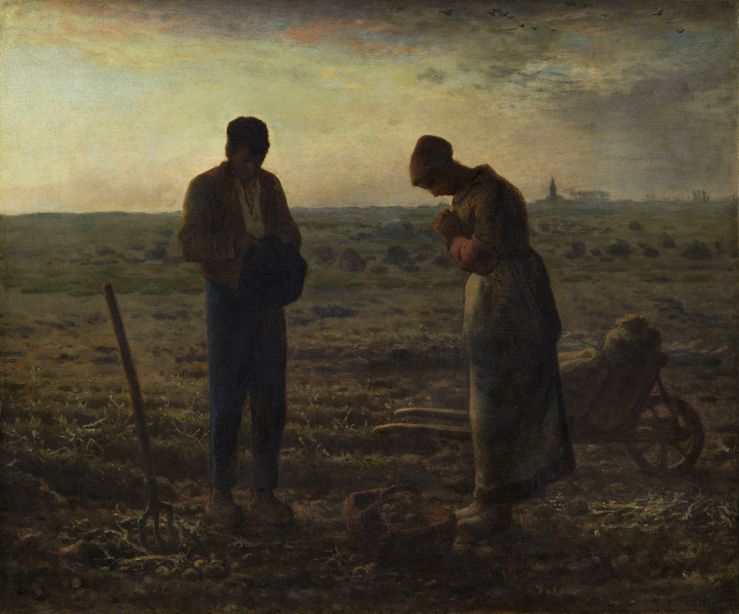
In Jean-François Millet’s The Angelus, two peasants stop digging potatoes to pray when the bells in the distance church tower ring.

I suppose one could say that church bells are a thing of the past. Of course, there are places where churches still have bells, and those bells still ring. They might ring at the beginning or during services (during the Lord’s Prayer, for example). They might even still ring to announce a member’s death or at certain times of the day. But the fact is that most of us live, work, and travel out of earshot of church bells.

I’ve been reading Martin Chemnitz’ 1569 Church Order for Braunsweig-Wolfenbüttel. In it, he has instructions of all kinds for church life in his principality. Today I came across his instructions regarding the ringing of bells, right after a long list of collects (prayers).

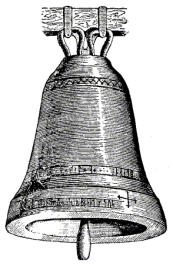
Under the papacy, a special ringing of the bell was observed morning, noon, and evening by which the people were admonished to pray to the Virgin Mary. But because the most blessed Virgin Mary does not desire the honor due God alone, and because it is also contrary to God’s Word, the people are to be instructed in this regard. The ringing of the bell in and of itself can be retained, as is also the case in the neighboring Reformation churches, to indicate to the people morning, noon, and evening. Moreover, the people are thereby reminded and exhorted to pray morning, noon, and evening for common peace and good government—in so doing prayer is made at the same time for the authorities and against all enemies of common, Christian peace. For this reason, in the neighboring Reformation churches, it has been very appropriately referred to as ringing the prayer bell or the “peace bell.” And it is Christian, good, and useful for the common people to be accustomed to it, so that they do not forget such necessary prayer. But because prayer is often forgotten, the peal of the bell can remind them to pray such things, whenever they hear the peace bell ringing, whether at home, in the garden, on the road, or in the field. At that time also, the children in the house may be encouraged to sing: Erhalt uns Herr bey deinem Wort, etc.; likewise, Verleihe uns Frieden gnediglich. Such prayer is of very great necessity in these latter and perilous days.
saleby_kyrkklocka_vastergotlandWouldn’t you say that prayer for the “common peace and good government” is still “of very great necessity”? And I’m pretty sure that forgetting to pray is no less a problem today than in 1569.

But if church bells are out—or perhaps drowned out by our world’s noise—is there anything that could fill the function of church bells to call us to pray? What could remind us, whether we are at home, at work, or in the car? Perhaps something that we carry with us practically everywhere.

Perhaps you could consider setting an alarm on your phone in the morning, at noon, and in the evening. You could even use the sound of bells to remind you to pray.

Verdin Bells has a few church bell sounds available for download on their web site. There is one called the Angelus (that’s the name of the papist bell-ringing Chemnitz refers to above) and one that is just a single swinging bell. Here are converted files for iPhone ringtones (Peace Bell / Single Bell).

Chemnitz encourages prayers for peace at these times. I think I might like to modify that just slightly with an area of focus for each hour—in the morning, for peace in the home and family; at noon (the hour of Jesus’ death), for peace in the Church; and in the evening, peace in the government and civil sphere. In another place I saw that some have used the morning hour to meditate on the Resurrection, the noonday to contemplate the Crucifixion, and the evening hour to reflect on the Incarnation.

The hymns Chemnitz suggests are also worth considering. Most Lutherans are familiar with “Lord, Keep Us Steadfast in Your Word” (CW 203). “Grant Peace, We Pray, in Mercy Lord” (CW 522) is worth knowing better. These two hymns always seem to be paired together. In J.S. Bach’s Cantata on “Lord, Keep Us Steadfast” the closing chorale is “Grant Peace, We Pray.” I love how it concludes:

Grant to our princes and all those in authority
peace and good government
so that we, among them
may lead a calm and peaceful life
in all godliness and honesty.
Amen.

Should Parents Advise Children to Postpone Marriage?

A Facebook friend recently posted a link to an old Issues, etc. segment in which this question was discussed. It is no secret that the age at which people get married has risen dramatically in the last several decades. (See Pew Research Study.) It is also no secret that the entire institution of marriage is under attack.

But the question was specifically raised whether Christian parents should advise their children to postpone marriage—until they’re done with school, established in a career, had the chance to date more people, or simply until a more appropriate age. Follow the link and listen to the segment. Hearing this reminded me of a few quotes I ran across in Part III of Martin Chemnitz’ Examination of the Council of Trent. In this volume he addresses Chastity, Celibacy, and Virginity.

Satan seeks to attack marriage in every age.

Behold, however, with how much contention, with what tricks and traps the enemy of marriage labored in early times to introduce the superstitious opinion of celibacy into the church! (151)

Living under a vow of celibacy was viewed as superior to marriage. But the reformers pointed out that not everyone is able to live celibate, because it is a gift not given to everyone (Mt 19:11). In addition, many vows were made by force and at an early age. In this section, Chemnitz considers the process of deliberating whether to take a vow or to be married.

“Therefore also [St. Paul] does not entrust the deliberation to people of youthful age, a time when counsel, wisdom, circumspection, earnestness, and constancy are lacking, but wants it left and communicated to the parents or to wiser adults, who are able to judge this matter more correctly, maturely, and diligently. Nevertheless Paul limits the power of parents to this extent, that children cannot be destined either for marriage or for celibacy against their own feeling, will, and ability by command of their parents, but he states that the deliberation of the father is to be moderated and directed according to the intellect, will, ability, and inclination, or, as the Greek translators speak, the opinion and impulse of the daughter…

Furthermore, in this deliberation Paul also wants the age taken into consideration…Before the prime, when the bodies are still growing, and passions and secretions are not yet complete, and have not yet reached their high point, purity can be preserved with moderate diligence by the help of God. And to this diligence the young are to be exhorted…Parents should indeed guard a virgin until she is of age and teach her what is better. (83)

But what about when the body is grown, when it becomes apparent this person does not have a gift to remain unmarried, and wishes to be married?

Paul does not give parents tyrannical power so that they are able to forbid their children marriage and drive them into celibacy against their nature and will, regardless of whether they have the gift of continence or not. (141)

I wonder if the advice (or the culture’s conventional wisdom) to postpone marriage until education and career are established, presents a kind of modern day forced celibacy. Except it’s usually not by force. And in many cases, they’re not really celibate. And that causes problems.

The vow of continence drives nuns to horrible sins, such as the killing of aborted infants, the destruction of nature by medicines, lust toward one another, and other unmentionable acts. (205)

Chemnitz uses the same argument for marriage as the Augsburg Confession: “‘because of the temptation to sexual immorality, each man should have his own wife’ and ‘It is better to marry than to be aflame with passion’ (1 Corinthians 7:2, 9b). Second, Christ says, ‘Not everyone can receive this saying’ (Matthew 19:11), where He teaches that not everyone is able to lead a single life…Therefore, those who are not able to lead a single life ought to marry. No human law, no vow, can destroy God’s commandment and ordinance.” (AC XXIII)

Chemnitz and the reformers repeatedly claim that vows or rules or churchly customs do not supersede the ordinance of God in creation and God’s desire for his gifts to be used within marriage. It seems that a question for today might be whether cultural norms, higher education, or career aspirations now trump the words of our Lord and his Apostle?