For those of you who haven’t seen this on Facebook or YouTube, here is a little video of the kids singing a few Christmas songs. We got a new video camera for Christmas, and it’s perfect for exactly this kind of thing. Hope you enjoy, especially Isaiah and Lydia’s “Dueling Christmas Carols.”
Author: Rev. Johann Caauwe
I am a Lutheran pastor in Wood Lake, MN.
Full
There’s something incredibly encouraging about sitting around a full dinner table with a fully lit Advent wreath, singing hymns of Advent and Christmas.
GPS
I’m pretty happy to have been able to get the TomTom app for iPhone, thanks to an unexpected honorarium I received. The app is on sale for $49 for a couple weeks. I use the GPS feature on my phone quite often. It will be very nice to be able to drive without having to keep watching the phone. That’s not very safe, especially when you don’t know where you’re going.
I turned it on this morning on my way to church and noticed something interesting. It told me that my exit is “Hondo Pass Rd.” It is true that a couple of the highway signs read “Hondo Pass Rd,” but most others read “Hondo Pass Dr.” I have also seen it printed “Hondo Pass Ave.” Apparently, no one seems to know what kind of road Hondo Pass is.
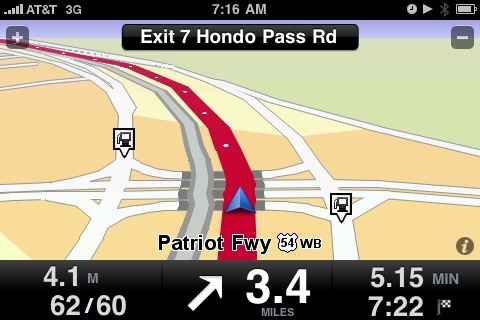
I have noticed that most people in El Paso don’t even bother with the type of street. Rd, Dr, Blvd, St, Ave, Way, Cir—those don’t seem to matter around here. I noticed that the first time I looked at Trinity’s directory when I was deliberating the call here.
That’s so different from the way it is, for example, in the Minneapolis area, where all the streets run east/west and the avenues run north/south. That way, if I have an address, I can pretty much guess where it’s at. That was rather useful to me the summer I spent delivering sod in Minneapolis. I suppose that being able to locate nearly any address on a grid of streets would eliminate the need for GPS, though, wouldn’t it?
Decorating
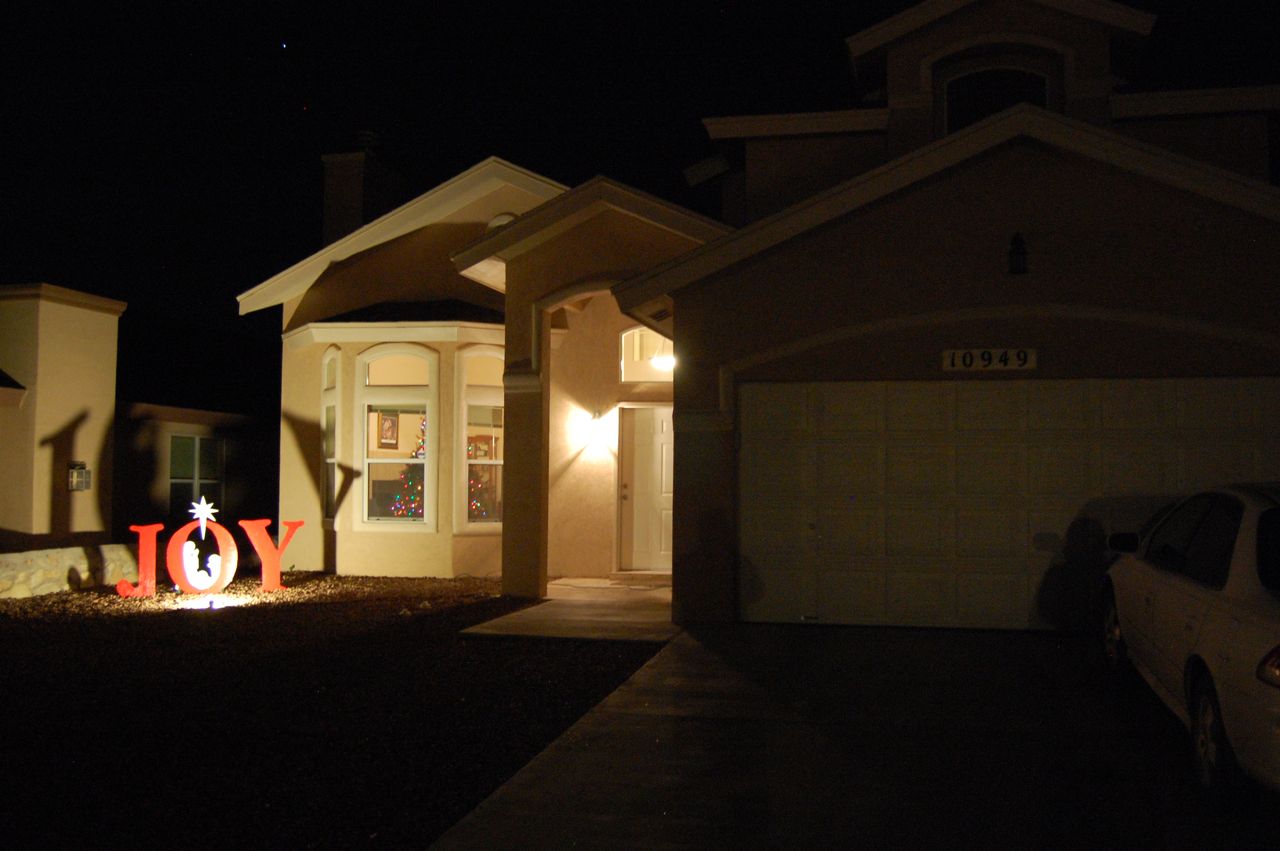
This afternoon we went and picked out our Christmas tree. After getting the tree up and lit, we also put up some decorations in the front “yard.”
A CMS Wish List
 I have written previously about the tools that a pastor uses as he carries out his ministry. From high-tech to low-tech, these tools assist the pastor in his work of caring for the flock. Church Membership Software is one such tool. This is software that stores a congregation’s records, including membership data, attendance, and sometimes its finance and other information. In some cases, these functions can be carried out in other ways. In the past, churches primarily used a big book called a church register. This book had lined pages for the congregation’s baptisms, confirmations, weddings, etc. Even today, smaller congregations could simply keep these records on paper, in a word processing document or a simple spreadsheet. Financial data can be managed in a stand-alone system like Quickbooks. But very often churches desire a single software solution to manage all its data. Those types of software packages are called Church Membership Software (CMS).
The CMS with which I am most familiar is called Shepherd’s Staff. It is developed by Concordia Technology Solutions, a division of Concordia Publishing House. Incidentally, I think the name Shepherd’s Staff describes the purpose of this type of software, a tool in the hand of those who have been called to shepherd the flock of God.
My opinion is that Shepherd’s Staff, and other packages like it, do their job well. They are, in general, mature products with deep feature sets. But I’m wishing for something more. For a couple years already, I have been looking for something better. There are two main reasons. #1: Microsoft Windows. I’ve been a Mac user for almost 13 years. I have never personally owned a Windows machine, and I have never really been interested in one. I have never had much trouble finding applications for the Mac—except for church software. Shepherd’s Staff is Windows only. Right now I have VMware fusion on my Macbook Pro which runs Windows XP. But the only reason I have that is for Shepherd’s Staff—and I cringe every time I have to open it. If there were a better alternative, I would quickly delete Widows from my machine.
But I’m not really looking for a Mac version of Shepherd’s Staff or another CMS. That leads me to reason #2: The internet. The web is filled with Web 2.o applications for everything from social networking (like Facebook, etc), photo sharing (Flickr, etc), even banking (Mint.com, etc). It just blows my mind how much of your life you can organize, publish, and discover, not to mention how much time you can waste if you’re not careful—all with a modern web browser and an internet connection. Some people even predict that in the future all software will be web-based. Right now, there are just some things that work better as regular client software, mostly because of the limitations of web browsers (for example, web-based word processors or presentation software do not compare to regular local software). But for database-type applications, the web is a fine tool.
My wish is for a good CMS on the web. There are a few products out there. I have links to them at the end of the post. Some are good, others are not, still others are too expensive. But the advantages of this type of thing are huge. Since it’s web-based, it would be platform independent. It wouldn’t matter what kind of computer you’re using. It would also be hardware independent. Sometimes church office computers aren’t the newest machines in the world. Web-based software eliminates the need for the users to update the software on their machines. That means that your version will always be up-to-date (I’m currently using a version of Shepherd’s Staff from 2004). It would also provide built-in back-up and the data is not stored at the church. I know of more than one church which was broken into and had the church office computer stolen, complete with the electronic church records. I can also imagine other disasters which would have the same results.
The other advantage to web-based software is that it is accessible from anywhere. That means that church volunteers or staff can access the system from home, church, or wherever. I can just imagine a financial secretary entering contribution records at home, or a volunteer taking home the attendance cards or friendship registers and entering Sunday’s attendance. As a pastor, I would love quick access to membership information no matter where I am.
But while there are a few of these kinds of tools out there, I haven’t yet found what I’m looking for. Basically I’m looking for the feature set of your typical CMS, especially Shepherd’s Staff. Here is a list of a few of my more desirable features. Feel free to add your own ideas in the comments section.
- Mobile Access – Ideally this would be an iPhone app. But at the very least, a mobile web version to do things like view and edit contact information for my members and prospects. I would like to be able to view their info, click on a phone number to call or click on their address to get directions. After a visit, I would like to be able to log my visit notes within the person’s record. I would also like to be able to take attendance for classes from the mobile version.
- Lutheran terminology I have tried several options out there, but it seems that many of them are built for megachurches that have different needs. Lutherans (and probably other sacramental/liturgical churches) have their own terminology and critical information. Baptism and confirmation dates are important. Membership types are unique. That’s one of the reasons I really have always appreciated Shepherd’s Staff.
- Tags I would like to see the ability to create groups by using a tagging feature. Most software allows you to create groups of members based on certain criteria. But I would like to be able to create those kind of “smart groups” based on tags that I have created. For example, we typically have three “types” of members: baptized, communicants, and voting members. But a typical drop-down menu doesn’t work for that, because our communicant members are also baptized members, and our voting members are all three. I would like to be able to simply assign tags to people. This kind of organization is used all over the web, including sites like Flickr and even blogs like this.
- Permanent Records One of the biggest dangers of using computer software to keep track of church records is that when the technology changes or the software upgrades, current data formats may become obsolete. The things that churches need to record are often permanent records, especially the official pastoral and church acts, such as baptisms, confirmations, weddings, and funerals. This is important in small churches and large churches. In large churches because there is lots of data and people can get lost. In a small church this is important even if the church is small enough for the pastor to remember all the details about his members. But when that pastor takes a call or retires, the new pastor will have to rely heavily on those records. I’m convinced that churches still need to be able to keep a hard copy of all of this kind of data. So even web software needs to be able to export reports that can serve as these kind of archived records. I would recommend keeping this hard copy record in a fire-proof safe at church or off-site (but make sure someone knows where it is).
- Attachments I want to be able to attach documents to personal or household records. I’m specifically thinking of scanned documents like baptismal certificates, transfer letters, marriage licenses, etc. That way our records can be stored off-site and are easily associated with a member’s other information. If there was an iPhone version, perhaps these attachments could be viewed from the phone.
Here is the list of web-based church membership software services. I know there are others, many of which are higher-priced. Leave a comment if you can recommend another.
American Lutheranism
A few weeks ago there was a segment on Issues, etc, with LCMS pastor Matthew Harrison on American Lutheranism. There was a section near the end of the segment that I thought was certain to be included in the show’s weekly “Soundbite of the Week” segment. This interview was chosen as the Soundbite of the Week, but for a different section of the interview. In this clip, Pr. Harrison sums up what he believes to be the most important thing that American Lutheranism needs today. I thought this little clip was soundbite worthy enough to clip out that little bit of audio for myself.
Here is the clip.
Or, you can listen to the whole segment.
Navidad de las Luminarias
Last night I attended the annual Christmas concert by the Bruce Nehring Consort in El Paso. I went last year, and wrote about it here. My impressions were pretty much the same as they were last year (since the sang basically the same concert). But it was worth hearing again.
First Week in Advent
It’s been an interesting week here in El Paso. It all started with rain that started to fall on Sunday. (Rain is always exciting here.) But the wind was picking up and the temperatures were dropping. By mid-morning on Monday it had turned to snow. Big, clumpy snowflakes. On Monday evening everyone was canceling activities (UTEP, the county courthouse, etc) By Tuesday morning we had couple inches on the ground. The public schools started two hours late. And even though the roads were all pretty good, we also waited until 10:00 to start.
This actually isn’t our first snowfall of the year. It snowed a few weeks back and the mountains got a little white on top.
It was on Tuesday that I also realized that the furnace didn’t seem to be working in church. Apparently, other people noticed it on Sunday, but hadn’t said anything. I tried to get someone to look at it, but that didn’t work out, and so our first midweek service was a bit chilly.
 What concerned me more than Wednesday’s service was the funeral scheduled for this morning. So last night we had a couple members at church working on the furnaces, but the units are outdoors on the roof, and it started snowing again around 7:30pm. They worked hard at it, but the snow kept them from finishing. Overnight, it laid down a nice layer of snow and ice that made this morning just as interesting. I left for church about 6:30. Since the car I’m currently driving parks in the driveway, the ice layer covered the car. I can’t remember the last time I have had to scrape ice off a windshield (2005, I suppose). Of course, I don’t even own an ice scraper or snow brush any more. Fortunately, a neighbor came to my rescue (who recently moved from Chicago). The roads were iced over and the sand trucks had not been out. It was 20 MPH all the way to church, but it was a little comical to watch the panic of people who really didn’t know how to drive on this stuff. The public schools delayed their start by two hours. But we had the funeral this morning at 9:30 and we had planned on having the school kids sing for the funeral. So we let parents know that we would start at 9:30.
When I got to church I discovered that it was 50º in church, so I did what I could to get a little heat in there and then tried to find a way to get some ice off the sidewalk. Of course we have no shovels or salt or ice scrapers. So I found a hoe and dug up some sand from the back of church (we do have plenty of sand out here). The hoe worked surprisingly well, and I used a broom to sweep away the broken ice and then sprinkled sand to provide a little traction.
The funeral seemed to go rather well, though a little cold. The funeral was for a 92-year-old WWII vet who survived the sinking of the troopship Leopoldville on Christmas Eve 1944 (look it up). He earned a purple heart for that and a second for being wounded in Korea. He was born in NE and raised in Minneapolis area (sound familiar?) but moved to El Paso to get away from the cold. Ironic that he was laid to rest on what should be the coldest day of the year, with snow still on the cacti.
Ours Paso

When we lived in California, our kids thought that our house was California. When we moved to Texas, we had to explain that other people also live in Texas, but they have a different number (house number).
Now, Isaiah says that we live in Ours Paso. If you don’t live in El Paso, you live in Yours Paso. We live in Ours Paso.
It’s kind of cute the way a two-year-old tries to express his understanding of places. But even if he doesn’t fully understand it all, he gets this: Ours Paso is the place we call ours, that is, it’s home.
Advent Wreath
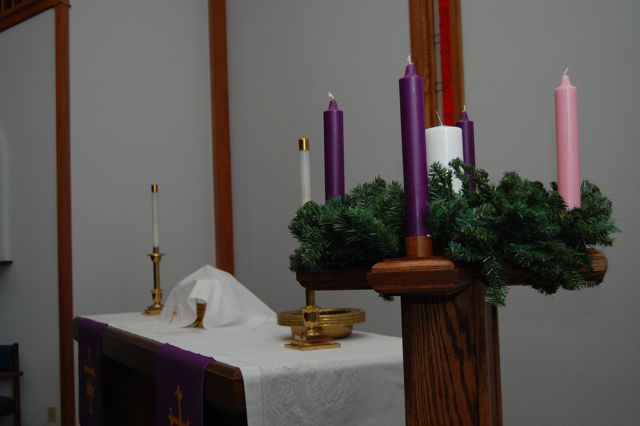
About two weeks ago I emailed one of my members and asked if he would be interested in making a stand for an Advent wreath for church. I realized that it was a little late, but I thought I would ask anyway. This morning before 8:00, Kenny dropped off this gorgeous stand. I picked up the wreath at Hobby Lobby yesterday. The candles were ordered from Almy. I think that this piece is a fine addition to our chancel appointments, and that it will serve us well for many years.
Here is an excerpt from a post by Pastor Johnold Strey on the history of the Advent wreath:
I’ve heard from more than one Lutheran source that Martin Luther is assumed to be the “father” or “inventor” of the Advent wreath. I suppose that makes for a nice story, especially if you’re a Lutheran, but unfortunately that doesn’t seem to be true. The best theory about the Advent wreath’s origins that I’ve heard came from one of my liturgy classes at Santa Clara University. The professor suggested that Advent wreaths originated in the colder climates of Northern Europe. Men would remove the wheels of horse-drawn carriages just before winter set in, when snow and muddy conditions would make such travel difficult. The wheels were brought inside, and possibly placed up in the rafters of houses. Eventually the muddy wheels were decorated with evergreen boughs, then candles, and voila — the origins of the Advent wreath at the time of the year just before Christmas.
In time, the use of the Advent wreath became wide spread and moved from the home into the church. The general symbolism of the Advent wreath lies in the growing light of the wreath: each Sunday another candle from the wreath is lighted as we approach the birthday of Jesus, the Light of the world. Advent wreaths have four candles around the circle, one for each Sunday of the Advent season. Modern Advent wreaths frequently include a fifth candle, the white “Christ candle” in the center of the wreath, which is first lighted at worship on Christmas Eve.
 A Shepherd's Story