Ultrasound

This morning I had the privilege of accompanying my bride to an ultrasound appointment. Yes, in early January we will be expecting our sixth child.

I was just about to write about the fact that no matter how many I see, it always becomes real for me when I see the little fingers moving around. Then I thought to myself that I might have written something like that. Here’s what I posted on September 22, 2008, when we saw Miriam for the first time:

Today we got to see ultrasound images of our littlest one. We’ve seen plenty of ultrasound pictures, but seeing those little arms and feet moving around never gets old. It always amazes me to see four chambers of the heart and a cross section of this or that, or to measure the skull or abdomen. But what always gets me are the little fingers and toes.

The remarkable thing is that it gets me every time, but the reason that it does (I think) is because each new child is a new child. Yes, they have so many similarities and they do so many of the same things. But the thing that gets me about the whole things is just how different and unique they all are. Nearly every day I marvel at some unique trait of one of the kids. And that uniqueness starts now. This baby at 18 weeks is not same as any of the others.

Seeing a new baby squirming around in the womb brings home to me the reality that—God-willing—I will now have the opportunity to get to know a brand new member of our family. It reminds me that my vocation as father just got bigger. It reminds me that God has heaped upon me and my family yet another blessing from his gracious hand.

Law and Gospel

This summer, besides reading through the book of Concord, I am also reading two other rather heavy books. The BoC reading, as I’ve mentioned before is just something I try to do every other year, and is a part of my daily devotions. The other two books are just the next two in my reading stack. Let me explain. I have a stack of books in my study at church that I intend to read. I add books to the bottom of the stack and read them when they get to the top. I have two books going at one time, one at home and the other at church. This disciplines me to not read books as soon as I get them, to read books that I really need to read but may not be my favorite, and to not read ten books at one time and never finish any of them.

Right now I am reading some fiction for a change, Leo Tolstoy’s Anna Karenina. The other book is C.F.W. Walther’s Proper Distinction Between Law and Gospel. Students who are training to become pastors are often told that they should read Walther every year. [I would be interested to know who first suggested that—because it seems to be universal advice.] I haven’t read it every year, but this is my fourth time through. I first read it one summer while in college. I was working out at Bush Lake Park and remember reading the book on my breaks. Time #2 was sometime while at Seminary. #3 was one of my first years in the ministry.

I remember struggling through the book the first time through, but simply being more and more delighted and refreshed with each subsequent reading. What I also realize now is that the struggle to apply the law and the gospel appropriately in the life and work of a pastor is indeed something that can only be learned in the “school of experience,” and that experience only teaches just how difficult this art truly is.

This month, Concordia Publishing House has released a new translation and edition of this classic work. They have updated the language and apparently provided a more authentic translation. I will miss all my highlighting and underlining from these previous reads, but I heartily welcome a new translation. I am sure that the translation contributed to my difficulty in reading the book the first time. I am still noticing that this time, especially now knowing that a new translation has been produced. In addition, the amount of additional material in this volume will make this book even more valuable. It is full of historical notes, maps, timelines, etc. I will continue plowing through the old edition (probably) one last time, and sometime, when I have the money to do so, I’ll pick up a copy of the new version and use that for reading #5. I guess I’ll just put it at the bottom of the pile, and I’ll get to it in about a year.

Law & Gospel: How to Read and Apply the Bible [CPH]

The New, Fresh, Powerful Edition of Walther’s Law and Gospel is Available Now [Cyberbrethren]

When I Told My Pastor [Weedon’s Blog]

As a Helper

On June 26, 1998, I was spending some time—as I often did—out at the farm with my Grandpa. We spent our time either working or talking. I knew that those conversations would not last forever, and so I occasionally brought along a little tape recorder and captured those stories that Grandpa told.

The conversations went all over the place, but on this particular day Grandpa had a few words about marriage. The tape recorder captured this little piece of advice, from an 89-year-old grandfather to his 19-year-old grandson.

You have to be careful who you marry. Your girl is going to New Ulm school. If she stays there, and you get married together, I probably will help you. Somebody that goes with you. It can be nice, if you can stay together. You don’t know where you will be sent; God will have to lead you. She goes with you as a helper.

Just three years later, on June 23, 2001, I married this girl after we both graduated from this school in New Ulm (Martin Luther College). Grandpa had told me that he would come to our wedding, and that he would help us. He never got that opportunity. But I have treasured these few words of wisdom that he shared with me that day. My grandparents’ marriage spanned 47 years—till death parted them. I assume that he knew what he was talking about. He knew that if husband and wife stick together, it can be nice—even if life isn’t always so nice and easy. He understood, I suppose, what it means to have a wife as “a helper suitable for him” (Gen 1:18).

I can’t say that I understood all that then. But as I reflect on those words today, and as I reflect on the nine years Sara and I have been married, I think to myself, “I do now.” She has gone with me as a helper, as I completed my training at the Seminary, as we packed up and moved to California and then to Texas. As a helper, she has become the mother of our five children and continues to nurture and care for them with diligence and patience. As a helper, she runs this household in such a way that allows me to serve as a pastor and spiritual father to the members of our congregation.

And so I realize that Grandpa was right. It can be nice. When we stay together. When we live within God’s design for marriage, as a head with his helpmate. When we serve each other. It can be nice. It has. That does not mean it has always been easy. It does not mean that it ever will be perfect. But God has given me a treasure, a gift, in my bride. And I look forward to every day that God has in store for us.

Concordia Observation #1: Churches and Schools

The Preface to the Christian Book of Concord records the intent and agreement of those who signed their names to the Formula of Concord and the other confessional documents of the Lutheran Church, which are contained in the Book of Concord. It provides a glimpse into just some of the issues present at the time and the reasons for their confession.

One of the things that jumped out at me during my reading of it was how often the phrase “churches and schools” is used. 18 times in these 9 pages Chemnitz and Andreae use this phrase. Only seldom do they mention their churches apart from their schools.

At first, it made me wonder what kind of schools they were talking about. Could they be referring to schools like the University of Wittenberg, which became a central source of teaching in Lutheranism? It was the teachers in these schools (like Philip Melanchthon, for example, who penned the Augsburg Confession and its Apology) who were among the first to stand up as confessors of the faith.

But after reading it, I am inclined to think that these schools were more than just their institutions of higher learning. These were schools which were attached to their churches. The churches and schools confessed the faith together. They were attacked by false teaching together. Ministers served in both churches and schools.

I still don’t know much about the form of these schools. It’s something I would like to investigate if I had the time. I would be interested to know how these schools relate to the kinds of Lutheran schools we have today.  But what I notice here is simply the fact that the earliest Lutherans identified themselves as “churches and schools.”

The Lutheran Church has a long history of operating schools in connection to their congregations. And when Lutherans came to America, confessional Lutheran synods were also quick to start schools. Lutheran schools, especially at the elementary and middle school level, have been a stronghold in church bodies like the Wisconsin and Missouri Synods. Of course, not every congregation had a school. But the confessors recognized a crucial role for our schools. The schools were a vital part of confessing the true Christian faith. And confessing the faith was the most vital part of their schools.

Today it seems that schools are viewed more as a liability than an asset. Schools cost money. Lots of money. And therefore, they are viewed as an optional luxury for congregations that can afford it. I’m not suggesting that every congregation must or should operate a school. I’m simply observing a different way of viewing our schools.

In addition, I think sometimes there is a thought that because our schools are viewed as an “outreach tool” (not a bad thing, necessarily), the confession in the Lutheran school must be somewhat muted, so as not to turn off non-member parents. Often parents aren’t looking for a specifically Lutheran education. Anything generically Christian will do, or at least a school that teaches “Christian values.” So we won’t make such a big deal about being Lutheran in the school, or at least we ‘ll just save that for the pastor’s catechism class for the older students.

I don’t recognize either of these attitude in our Lutheran confessions. Their schools were a part of their identity, and the confession of Lutheran doctrine was their school’s identity.

We regularly hear news that our schools are not in the best of shape. Schools are closing. Others are shrinking. There are all kinds of reasons for these things, from the economy and the cost of tuition, to the parents’ priorities or the congregation’s level of support. Our congregations don’t have as many children as they used to, in part because parents don’t have as many children as they used to. In short, there are all kinds of things that ail our Lutheran schools.

But I believe the ultimate answer—if we want to keep Lutheran schools—is to keep our schools Lutheran. This means that our teachers ought to be well trained in Christian doctrine, including these Lutheran Confessions.We ask our school teachers to conform all of their teaching according to the Scriptures and the Lutheran Confessions. It means that the mission (even vision or objectives) ought to flow from this same confessional standard. It means that our main objectives are those things that allow church and school to confess the faith together. It means that our curriculum is going to have Lutheran catechesis as a central element rather than an awkward appendage.

I think about these things quite frequently, as I have always been (since kindergarten) involved in some sort of Lutheran school, and now also serve as acting principal of our school. And we are currently working through the accreditation process for our school, which has us documenting and articulating the purposes and plans for our school. So when I came across this constant repetition in the Preface to the Book of Concord, these words struck me as a most excellent model for own churches and schools:

We conclude that nothing more agreeable could happen or should be sought more eagerly and prayerfully from almighty God than the following: (a) both our churches and our schools should persevere in the pure doctrine of God’s Word and that longed-for and godly oneness of mind, and (b) as was the case while Luther was still alive, they should be regulated by the divine Word, which was handed down to posterity in a godly and excellent way.

Related post: Our Schools

Reading

I am encouraged by the response to my last post about reading the Book of Concord this summer. There were more than a dozen people who commented on the blog or emailed me to say that they were going to be giving it a try. About 40 people have logged into Google Wave to follow the discussion there. Perhaps what I’m most encouraged by is variety of people who are excited to be reading the Book of Concord, especially the number of lay people who are reading it for the first time. So many have said, “I’ve always wanted to read the whole thing.” I would expect Lutheran pastors to do it. It should have a regular place in their reading and study schedules. But as the section I quoted in the previous post notes, the Lutheran Confessions were never meant to be for clergy only. And it always encourages me to know that lay people are interested in really learning what it means to be a confessional Lutheran.

When I was in college I received a bunch of books from the family of my great-uncle, who had just passed away. I visited him just days before he died, and sang some German hymns to him in his final days. He wasn’t a pastor. He was a farmer. But he was also a student of the Scriptures. Among the books I received were a bunch of music books, a book of Walther sermons, Stöckhardt’s Bible History Commentaries, and a German-Latin edition of the Book of Concord. Uncle George wasn’t a pastor, but he wasn’t a stranger to theology either.

I hope that the discussion is helpful in keeping everyone on schedule this summer. I’m still not convinced that Google Wave is the best tool for this kind of discussion. It’s pretty new, and most people are just getting used to it. But it seems to be working. If you aren’t interested in digging into Google Wave, you can try to start a discussion on the Book of Concord Facebook page, or leave me a comment on this page. I’m looking forward to hearing people’s questions or observations as they read. It’s already been quite interesting to see the thoughts that people have been having. I will be occasionally posting some of my more general observations from this summer’s reading here on The Shepherd’s Story.

If you’re still interested in starting, it’s not too late. We’re just starting the Augsburg Confession. If you still need/want to pick up a copy of the book, right now the best price is at Amazon.com. I’m sure they’ll go on sale a CPH again.

Happy reading!

Read With Me

This summer I will be reading through the Lutheran Confessions, and I wonder if there is anyone out there who would like to read with me. Several years ago I came across a schedule for reading the Book of Concord during the summer (May 30–September 6). I like doing it in the summer because my schedule is a little lighter, and it seems better to read this in longer sections, rather than to spread it out over the whole year (using the schedule included in the Reader’s Edition).

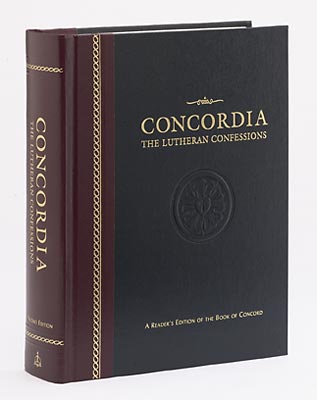
I will be using the CPH Reader’s Edition (Concordia: The Lutheran Confessions) again. This has become my standard English version which I use.  If you don’t have a copy of the Book of Concord, get one. Read the paragraph below to explain why. It is currently on sale for $20 at cph.org. If you have a different version (Triglot, Tappert, Kolb/Wengert), there is an older version of the summer schedule here. If you don’t want to buy a book, you can read it on the internet right here, or purchase an electronic version here. You might also consider the pocket edition if you want to keep reading while on vacation and not have to lug a big book around.

Are you interested in reading with me? If so, I’d like to hear from you. Perhaps we can even discuss a few topics as we go through it. I’ll warn you that the schedule is pretty ambitious. This is the third time I’ve attempted this schedule and I’ve never yet finished on September 6th. But maybe if I had a few reading partners, you can help me stay on track. You can download the schedule through this link.

This is not just a book for pastors and church “professionals” or “academics.” In fact, it is important to realize that the people most directly responsible for the Lutheran Confessions were laymen, not pastors and theologians. At tremendous personal risk to their own lives, their property, and their profession, laymen boldly stepped before the emperor and the pope’s representatives. They asserted that these Confessions were their own. They did not back down or compromise. For this reason, it is unfortunate that down through the years the Book of Concord has come to be regarded more as a book for pastors and professional theologians.

Tucked into the middle of this book is the most widely used of all the Lutheran Confessions: Martin Luther’s Small Catechism. Luther wrote this document not simply as a resource for the church and school, but, first and foremost, for the head of the household. Luther intended this little book to be used by laypeople, daily, to help them remain anchored to the solid teachings of God’s holy Word, the Bible. So keep this important fact in mind: The Book of Concord exists because of the faith and conviction of laypeople, who risked their very lives in order to have these Confessions produced, published, and distributed. The Book of Concord is a book for all Christians, church workers and laypeople alike.

Christians who want to be true and faithful to the teachings of the Bible return, again and again, to this book. In these confessions of faith they find agreement, unity, and harmony in the truths of God’s Word. (from the General Introduction to the Book of Concord)

So dust off those Concord Books and we’ll get started in just a few days!

Meant to be…

There’s a line in the movie Lonesome Dove when the Hat Creek Cattle Company is about to drive their cattle herd through its first dust storm. One of the cowboys says to another (I can’t remember who), “Well, I reckon this is where we find out if we was meant to be cowboys or not.”

I find myself thinking of that line every time I find myself in a situation that seems to require a higher level of pastoral expertise than I imagine myself being capable of.  It may be a phone call that requires me to give pastoral counsel on the fly, for a situation I’ve never even dreamed of. Or the visit to a member’s home that brings to light an aspect of their life that no one else knows about. It could be a trip to the emergency room or to the county detention center, when I have no clue what condition this particular soul is in—until I walk through the door.

But I keep riding into these storms, wondering to myself how I’ll find my way out. I think that this is where I’ll find out if I was meant to be a pastor. I get there and I may stumble around for a while, but usually Jesus’ words find their way to my lips. Then things seem to become more clear. Then I know that, ready or not, Jesus has called me to do this work on his behalf. He has called me to serve these people as their pastor, which means sometimes stepping into unknown places, and into a world entirely different than the one I know.

Yesterday was Assignment Day at the Seminary. We watched the call service via the internet with the upper grade students. Our teacher’s brother was being assigned. As I think back to those days, I realize that we were well prepared to enter into the pastoral ministry. By the time a candidate’s name is read, he’s ready to go, ready to be a pastor. But I find that there is a whole lot more preparation that goes on every day, with every visit, every phone call. I find that I am constantly learning what it means to be pastor, to these people, at this time, in this place.

Christ Is With Me

This year our theme for the school year, especially for our weekly chapel services, was taken from this hymn from Christian Worship Supplement, “Christ Is With Me.” During the year, I covered as many aspects of Christ’s presence among us as I could, generally following the themes of the church year. Here are a few highlights:

  • September: Christ is with us when we gather in his name. Because of his promise, he is with us when we worship him, from invocation to benediction.
  • October: Christ is with us at all times and in all places. We noted God’s presence by night and day, and no matter where we might travel.
  • November (End Time): Christ is with us to the very end. Whether that is the end of our earthly life, or the end of this world, Christ will never leave.
  • December: God is with us in his son, Immanuel. Now that he has become our brother, Christ is never separate from us, for he is one of us.
  • January: In baptism, we are connected with Christ. His righteousness is ours; our sin is his.
  • February: Christ is with us through cross and suffering. In fact, especially in times of danger, fear, and sadness, Christ assures us of his presence.
  • March (Lent): Christ is with us because he suffered and died. He was abandoned by his people, his disciples, and finally by God himself. Left alone, so that we never would.
  • April (Easter): Christ is risen. Had he remained in the grave, he could not be with us. But a living Christ can keep his promise to never leave us.
  • May (Ascension): Jesus left his disciples when he ascended into heaven, but not really. In fact, when he sits on his throne, he is closer than ever before. Jesus’ ascension guarantees his presence with us constantly, and especially in the means of grace.

This is just a summary of a whole year of chapel devotions. This Sunday, our students will be singing this hymn in church. Our kids have been practicing at home, and so I have had the privilege of listening to these deep scriptural truths sung to me by the kids. The verses are paraphrases of verses from Romans 6, John 15, and Galatians 2.

We were buried with him into death,
That as he was raised by God’s glory,
We might walk in life made new by grace.
Having died with Christ, we shall live with him.

Refrain
Christ is with me ev’rywhere I go. Never to leave me, this I know.

I have now been grafted to the vine,
Drawing life from roots rich in mercy,
Bearing fruit as I abide in him:
Fruit forever fresh, glorifying God.

Refrain

I have now been crucified with Christ.
I no longer live; Christ lives in me.
Now I live by faith in God’s own Son,
One who loved me so—gave himself for me.

Refrain

Text: Gerald Patrick Coleman, b. 1953, alt

Ascension Afterglow

A large, framed picture of this stained glass window hangs in my study at church. The window is located in the balcony of St. John’s Lutheran Church in Wauwatosa WI, where I spent my vicar year. I received the print as a seminary graduation gift. While I was in California, the picture hung in my office, in just the right position so that I could see it from the front of church. Every time I raised my hands in blessing at the end of the service, I could see Jesus’ outstretched arms. Indeed, the benediction is his blessing. Today, I can’t see the picture from our chancel, but it still often reminds me of Jesus’ ascension. I have found that Jesus’ ascension has provided me with tremendous comfort for my life and ministry as long as I have been in it.

For the past seven years, I have been privileged to participate in worship services on Ascension Day, 40 days after Easter. I know that many churches no longer observe Ascension on this day (many transfer it to the Sunday after), but at this point, I just couldn’t imagine not marking this day. In fact, I have been told that my current congregation had never had an Ascension service before last year. But I have said that since I would be observing it anyway (on my own or with my family), I might as well invite others to join me.

I understand that Jesus’ ascension doesn’t rank up there with Christmas and Easter (in the minds of most people). I understand that Thursday nights in May are often busy with all kinds of activities. I understand that Hallmark and Walmart don’t have Ascension aisles—no one makes any money by getting you to celebrate Ascension. I get that. But none of that takes away from the mighty significance of Jesus’ Ascension, and the importance of ordering our lives around these monumental events in the life of Christ. The fact that people don’t celebrate it and don’t think much of it does not take away from the fact that 40 days after he rose, Jesus ascended and now sits at the right hand of God as our exalted brother who rules all things for the good of his church. His Church would no longer exist if he didn’t do that. I wouldn’t be a part of it if he hadn’t ascended.

Since it is such a high festival in the church year, a neighboring pastor and I decided that we would work together to plan a service that could rightly be called a festival. We used a special setting of the liturgy (Missa Pacem). A choir made up of members of two congregations led the way through the service. The service was accompanied by organ, piano, trumpet, handbells, and violin. And to top it all off, we knelt side by side and received the body and blood of our ascended Lord, in an uncommon opportunity to enjoy the communion fellowship we share with our sister congregations.

Our hope is that if we treat it like a festival, perhaps other people will, too. Perhaps if we preach it for what it really is, some might also come to appreciate its importance in the life of the Church, and in the life of every Christian. Unfortunately, we still had only 69 people in attendance. About 30 were in the choir loft. Last year we had 47 here, but that was just members of our congregation, and just shy of half our normal Sunday attendance.

But I have no regrets about doing the service, or how we did it.  I don’t think that it was at all a waste of effort or time. We pulled out all the stops. We made use of the best of our resources. We celebrated. We feasted. Perhaps with time it will be different. Perhaps more will come next year.

But if we have to wait until Jesus returns in the same way his disciples saw him go into heaven before we see huge crowds, so be it. Until then, I won’t be surprised to find that the group who looks up into the clouds continues to be rather small.

But when Jesus comes, even if that falls on a Thursday in May, people will come to that. The trumpets will sound. Alleluias will be sung. Jesus will be there. And his people will come. From every nation, tribe, people and language…

Collect for Cantate

One of my favorite collects (Prayer of the Day) in the whole year comes up tomorrow for the 5th Sunday of Easter. I think that part of this prayer might also show up on another Sunday, but this is just precious:

O God, you form the minds of your faithful people into a single will. Make us love what you command and desire what you promise, that among the many changes of this world, our hearts may ever yearn for the lasting joys of heaven.

Wow. Just think about all the things that you want, that you desire. “No, Lord, what I really want is whatever you have promised me.” And won’t that just be so much better than what we would have thought of? Isn’t it always? And won’t that always lead us to—above all else—yearn for Jesus to make good on that final promise?